
Capability begins with the question it needs to answer
A promising scientific idea needs a way to become testable. A product developer may need to compare formulations. A researcher may need a model that represents the biology more faithfully. A manufacturing team may need to understand what changes when a process grows.
NEUVIOR is scoping scientific and technical capabilities around those decisions. Formulation, analysis, manufacturing readiness and intelligent operations form four connected journeys. Specialist expertise and access can support a focused investigation before a company commits to its own laboratory or a larger facility. These pages explain the work we want to enable and the evidence a useful development step should produce.
Development journey
Begin with the decision. What must a product do, who will use the evidence and what would justify the next stage? Translate that question into the properties, comparisons and practical conditions that matter.
The journey then connects disciplines. Formulation defines and compares product options; analysis establishes how their relevant features can be measured; process development examines repeatability and transfer; intelligent operations asks where data, models or automation could improve the work. The value is in how the answers fit together. A strong result in one discipline can still leave a decisive question elsewhere unresolved.
Development examples
Imagine a small development business choosing between two product formats. The useful comparison could include material behaviour, measurable performance, storage requirements and the work a manufacturing organisation would inherit. The result should help the business choose which option deserves further development.
For an industrial research team, the question might concern recovery of a material from a process stream. A useful study would compare the recovered material, the resources consumed and the demands of using it again. These are illustrative tasks, rather than completed NEUVIOR product cases. They show how a capability brief can connect scientific work with an actual decision.
Bioprocessing
Biological production brings living systems and process conditions into the same question. An interesting output has to be considered alongside the conditions that produce it, the variability between runs and the work needed to recover or characterise it.
Our future bioprocessing interest concerns that connection between biological behaviour and a practical process. A focused study would establish the material, the relevant comparison and the expertise required before choosing a larger development route. Access to an experienced specialist can help expose a weak assumption early, while keeping the investigation proportionate to the maturity of the idea.
A capability connects more than one instrument
This external bioreactor figure connects chamber design, a physical vessel and its recirculation environment. It makes the capability brief concrete: which relationship must the proposed model or process preserve before specialist access or a larger system is chosen?
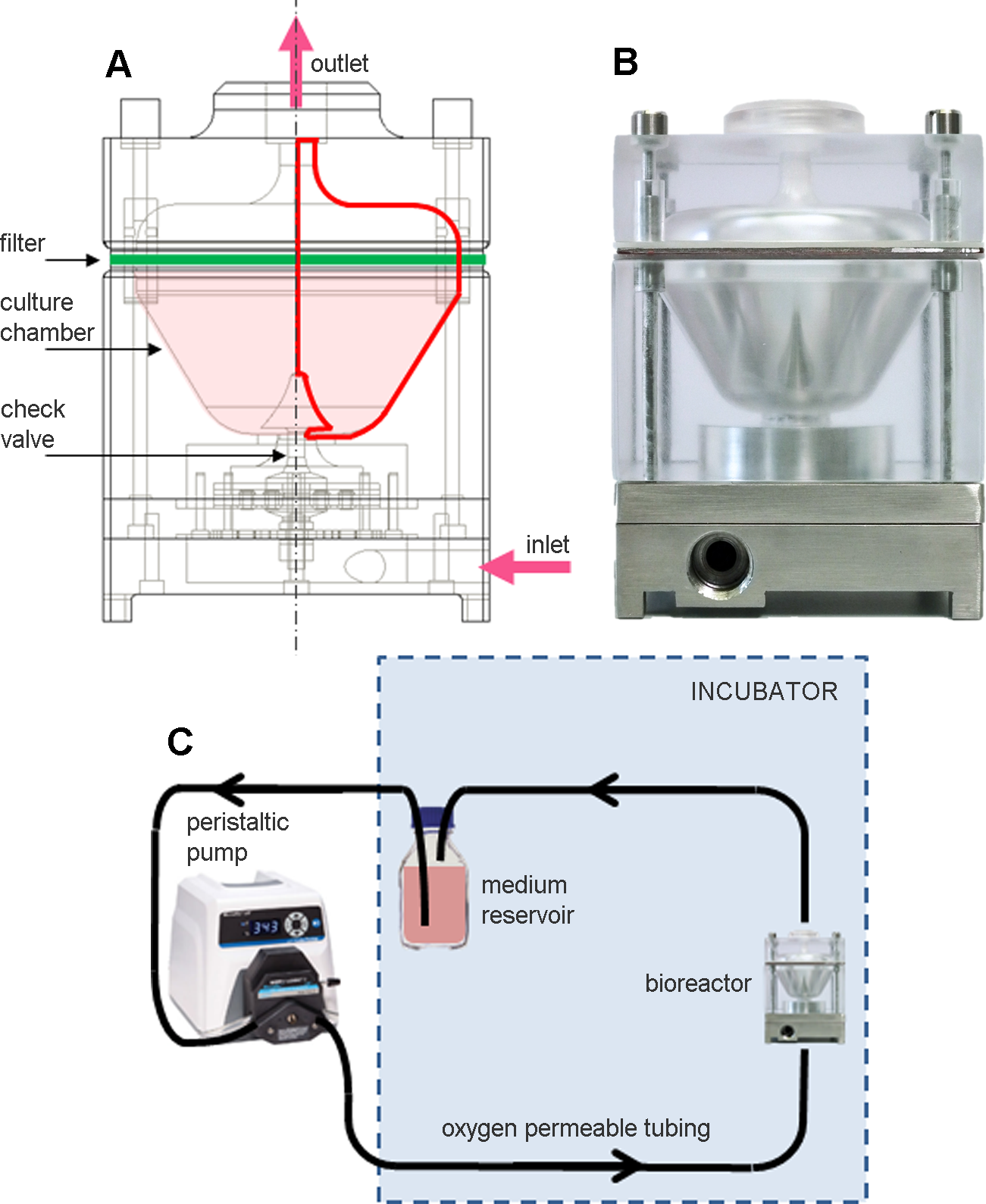
External published apparatus: Massai and colleagues’ dynamic suspension bioreactor and recirculation set-up (2016, Figure 1). This is the authors’ research system, not NEUVIOR equipment, an installed capability or an available service.
Diana Massai; Giuseppe Isu; Denise Madeddu; Giulia Cerino; Angela Falco; Caterina Frati; Diego Gallo; Marco A. Deriu; Giuseppe Falvo D’Urso Labate; Federico Quaini; Alberto Audenino; Umberto Morbiducci · A capability connects more than one instrumentCC BY 4.0 | Inspect the complete figure
Source and image notes
Complete figure retained; proportionate resize from 1301×1589 to 1301×1589 pixels using Lanczos resampling; lossless WebP encoding. No cropping, relabelling, recolouring or panel removal.
Scientific capability | Buy the answer before the equipment
Which capability would remove your next development uncertainty?
A formulation question, an uncertain measurement and a transfer problem can require different expertise even when they concern the same material. Select the decision lens to identify what a useful capability brief would contain. The final question is whether specialist access or an owned resource serves that need; the diagram does not advertise an installed laboratory or available testing service.
Editorial decision model, not measured NEUVIOR results. Spatial positions indicate relationships, not measured quantities.
Start with the uncertainty that limits interpretation.
A scientist can use this map to distinguish a product question from a measurement or model problem. Those gaps may need different collaborators. A focused brief should identify what the selected capability would establish and which uncertainty it would leave for a later stage.
Describe the claim, its weakest assumption and the capability that could test it.
The product choice
A capability request becomes more useful when it names a product or material choice that could change. The comparison might concern a formulation format, a recovery route or a preparation requirement. A broad request for laboratory access can hide that decisive uncertainty.
- Defines what must be measured
- Defines what must be represented
The intended product or material, its alternatives and the choice the evidence must inform.
A useful next stepWhich option would you choose differently if the investigation were informative?
A precise capability brief can turn a large infrastructure wish into a smaller decision someone can investigate.
A model can connect flow and cell behaviour
Capability includes knowing when different kinds of evidence must meet. This published bioreactor simulation brings flow and cell behaviour into the same visual field, providing a reference for discussing model assumptions, parameter provenance and the experimental observations needed to constrain a coupled prediction.
Published computational test case from a multi-paradigm bioreactor model. This is a simulation; it is not video of a production vessel or a validated NEUVIOR digital twin.
Kaul H, Cui Z, Ventikos Y · A model can connect flow and cell behaviourCC BY 2.5 | Original research and methods
Source and image notes
H.264 viewing copy; complete frame retained with proportional downscaling where required; no colour enhancement, crop, speed change or added frames. Audio omitted; original source remains linked.
Distinguish the layers
Flow, concentration and cell behaviour represent different model components with different assumptions.
Look for independent constraints
Agreement inside a simulation cannot substitute for measurements that test its inputs and predictions.
Translational biology
A research model needs to answer the intended biological question. Repeating a result in an unsuitable model can create confidence without bringing a programme closer to a useful development decision. Model choice, reproducibility and the interpretation of response deserve attention from the outset.
This proposed capability connects with NEUVIOR’s wider Biomedical Research direction. Specialist model access, experimental design and independent challenge could help a programme assess whether a finding deserves further investigation. The relevant output is an interpretable comparison, with a clear account of what the model represents and which questions require another approach.
Quality and regulatory science
Scientific knowledge becomes more useful when another qualified person can reconstruct how it was produced. Material identity, methods, versions, unexpected observations and the reasoning behind a decision all contribute to that account.
Quality and regulatory expertise should shape a study around its intended purpose and development stage. An exploratory comparison, a transferred analytical procedure and manufacturing release require different evidence and responsibilities. The aim is to prepare useful knowledge for the next recipient, so that a receiving laboratory, development organisation or future manufacturer can judge what is established and what remains to do.
Future intervention research
Our longer-term interests include the relationship between precision tools, human judgement and scientific intervention. Any investigation in that area would begin with a narrow research question, appropriate specialist leadership and a suitable non-clinical model.
A simulation or physical phantom could help explore a defined handling or navigation problem before any larger programme is considered. That future interest remains distinct from our current commercial priority in medicines intelligence. Its place in the portfolio depends on a convincing question, relevant expertise and a justified development route.
Access, expertise and the next useful study
An owned laboratory brings control and continuing obligations. Access to specialist expertise can make sense when demand is intermittent, the method is specialised or the programme needs knowledge that would take time to build internally. The comparison should include people, quality, scheduling, data rights and the full cost of delivery.
NEUVIOR’s initial ZYLON work involved specialist laboratory input at the  Biorenewables Development Centre in York. That bounded experience makes the access model tangible. Tell us the question, the material or data available and the decision you need to make. We can explore a suitable research scope and the capability it would require.
Continue the programme
- Formulation strategy
Read about formulation strategy at NEUVIOR, the evidence behind the work, and the decisions required for its next stage.
- Analytical development
Read about analytical development at NEUVIOR, the evidence behind the work, and the decisions required for its next stage.
- Manufacturing readiness
Read about manufacturing readiness at NEUVIOR, the evidence behind the work, and the decisions required for its next stage.
- Intelligent operations
Read about intelligent operations at NEUVIOR, the evidence behind the work, and the decisions required for its next stage.















