
What could a material become next?
Medicine asks a great deal of a material. It may need to protect, contain, handle or support a demanding process, while meeting the practical requirements of manufacture and use.
ZYLON is NEUVIOR’s completed initial feasibility work on bio-derived materials and selected resource-recovery questions. Its value is in the next application it helps us examine.
In the conversation.
NEUVIOR and our founder’s perspectives have appeared across science, business and technology publications.








Reporting, commentary, letters and podcast appearances | Read each feature for its format and source.
Begin with the function.
A useful material proposition starts with a job. What does the existing material do, under which conditions, and which property would make an alternative worth considering? That specification gives the research a destination and gives a prospective industrial user a reason to pay attention.
Our materials questions include seaweed-derived candidates and selected packaging uses. The next development opportunity lies in matching a candidate to a defined requirement, then comparing it with an appropriate incumbent. A material’s origin is one part of the story; its performance in the application gives the story practical meaning.
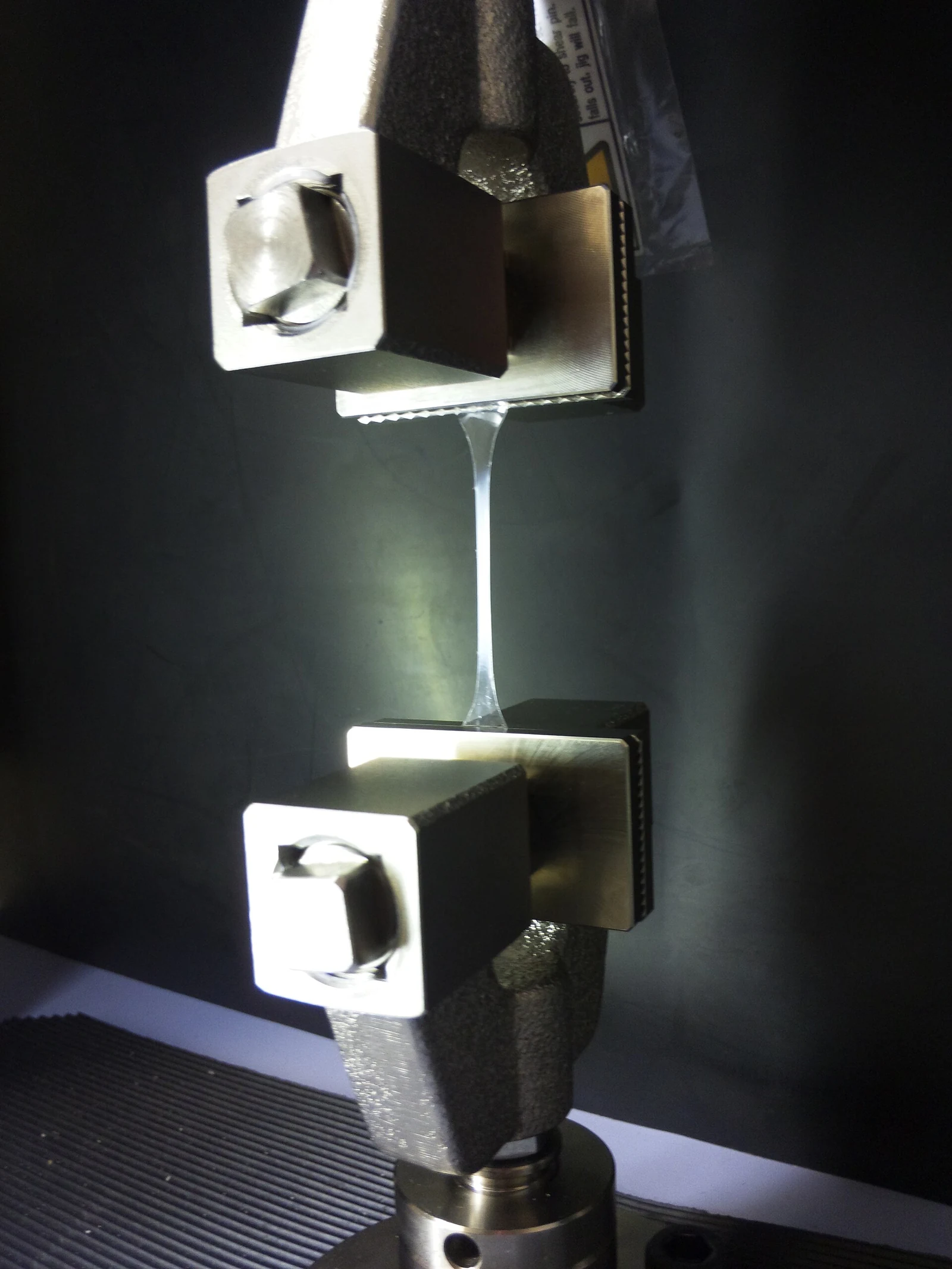
A polymer specimen under tensile loading makes deformation between the grips visible. External testing photography by Skatesandy, 2015; this is not a NEUVIOR ZYLON sample or result.

Make the sample’s behaviour understandable.
A film can behave differently as its composition, thickness, preparation or surrounding humidity changes. Handling, storage and processing conditions also influence what an industrial user can rely on. These details are the bridge between a promising sample and a useful development proposition.
Further characterisation would need to connect those conditions with the property the application requires. The question is where the candidate performs consistently, which conditions expose a limitation and which formulation or preparation change deserves another test. That makes the next experiment more informative to a potential adopter.
Give recovery a destination.
A recovery process becomes valuable when its output can serve a defined purpose. Yield, purity and consistency matter together. The additional processing needed to reach the specification matters too, because it shapes resource demand and operating cost.
Our recovery questions therefore connect the input material with a plausible next use. What has to be separated or removed? What must remain? Which organisation could use the output, and under what conditions? Answering these questions helps establish whether a recovery route deserves further development.
Materials development
Where does a promising material become useful?
A material can be intriguing before anyone knows where it belongs. Explore the path from a candidate film to an application brief: what it must do, the conditions it must tolerate, the comparison it must survive, and the claim the resulting evidence could actually support.
Editorial decision model, not measured NEUVIOR results.
Characterisation should answer an application question.
The researcher can connect a measured property to the condition that produced it. That makes an unexpected result useful: it may narrow the application window, reveal a preparation dependency or identify a comparison that should stop before more development resource is committed.
Agree the acceptance criterion and conditioning protocol.
Required function
A barrier, protective layer and handling aid place different demands on the same sample. Start with the incumbent function and its acceptance criteria rather than choosing an application because the material looks compelling in a photograph.
- Test the actual requirement
Application requirement and incumbent performance criteria.
A useful next stepWrite one property that would make the candidate worth testing.
ZYLON’s next useful step is a defined application comparison, not a broader material claim.
Follow the resource through the whole application.
A useful comparison includes more than the mass of one sample. Production, processing, transport, useful lifetime and the realistic route after use can change the result. A different material may ask for different equipment, handling or end-of-life arrangements.
The ACS Pharmaceutical Roundtable uses process mass intensity to examine material inputs relative to product output. That discipline offers one useful reference, alongside energy and life-cycle considerations. For ZYLON, the proposed application determines the measurements that are meaningful and the boundaries that must be visible.
A material has to do something useful.
The useful next question is about function: what the material must withstand, how it behaves in the intended application and whether recovery preserves enough value for another use.
A beautiful surface does not answer that question. The comparison needs a specification, appropriate measurements and a realistic alternative.
Carry initial feasibility into a focused next study.
The completed initial study involved laboratory work with the  Biorenewables Development Centre in York. It provides a feasibility record from which a more specific development question can be shaped. It is not an operating manufacturing line or a claim that a commercial packaging material is ready.
A useful next study would identify the application, the incumbent, the required property and the result that would change the development decision. Those choices help concentrate resources on a comparison that could establish a credible reason to continue.
NEUVIOR Data Analysis
A source.
A question.
A clearer decision.
Useful intelligence keeps its evidence attached.
Our public analysis connects a defined question with named sources, reporting periods and methods. Each source below shows the work available today and the access still needed.
Published-data analysis, research hypotheses and evidence studies are distinct kinds of work. Their meaning should remain clear as the programme grows.
Department for Energy Security and Net Zero | Annual, with revision notices
Greenhouse-gas conversion factors 2026
Which dated factor and accounting boundary fit a measured resource activity?
Dataset retrievedAmerican Chemical Society | Green Chemistry Institute | Method reference; inspect dated guidance
Process Mass Intensity method
Which material inputs dominate a process, including water?
Method referenceEuropean Medicines Agency | On guideline revision
Chemistry of active substances guideline
What process, recovered-material and impurity controls belong in a resource proposal?
Document retrievedBuild the claim from the evidence.
Resource innovation becomes more useful when a reader can understand exactly what improves and under which conditions. A bio-derived input, a recovered output and a recyclable product answer different questions. The evidence needs to match the claim being made.
We want future ZYLON communication to connect the measured property with its application and comparison. Environmental statements would need the relevant scope and life-cycle evidence. This gives potential users a clearer basis for discussion and protects the value of a promising finding from a claim that reaches beyond it.
Which material question has a useful industrial destination?
A defined application, a credible incumbent and an appropriate specification can turn a broad materials ambition into a revealing next study.