
Understand the biology that keeps a disease unresolved.
A treatment response can reveal progress while leaving important biological questions open. Which cells remain, what supports them and which functions must a future intervention preserve?
Biomedical Research is one part of NEUVIOR’s wider research landscape. Our initial focus is glioblastoma recurrence, connecting treatment-surviving cell states with a possible therapeutic development rationale.
Ask a question that could change the next experiment.
A useful research question identifies the biological behaviour that matters and the evidence needed to understand it. Finding a marker or observing a response can open the investigation. The development question concerns what that observation means for a mechanism and a potential intervention.
Our initial programme asks how malignant cells surviving treatment contribute to regrowth. It connects identity, treatment history and function over time. This gives the work a focused purpose: identify which explanations can be tested and which result would make the next study more revealing.
Understand a changing population.
Glioblastoma contains malignant cells in different biological states, and those states can be influenced by their environment. Published single-cell work has made that diversity clearer. A snapshot of a population therefore needs to be considered alongside how the cells behave and change.
This matters to a programme concerned with recurrence. Cells that are present after treatment may have different roles in what follows. Our proposed work seeks to distinguish direct regrowth, support for other survivors and association with recurrence. Those explanations require different experimental comparisons.
Connect a vulnerability with a defined cell state.
One selected question concerns GPX4-related biology. Published preclinical research has identified a ferroptosis vulnerability in particular quiescent astrocyte-like glioma populations. That provides a specific line of investigation within a more complex disease system.
Our development interest is in whether a useful dependency remains in the relevant treatment-surviving setting and what an appropriate sequence of interventions would do. The state, model and surrounding conditions matter. A result needs to explain the population affected and the behaviour observed, rather than turn a target name into a universal treatment promise.
A tumour changes the surrounding circuit
Published human electrophysiology gives the question of neural function a concrete setting. Inspect the original measurements beside the programme’s distinction between tumour response and the surrounding system.
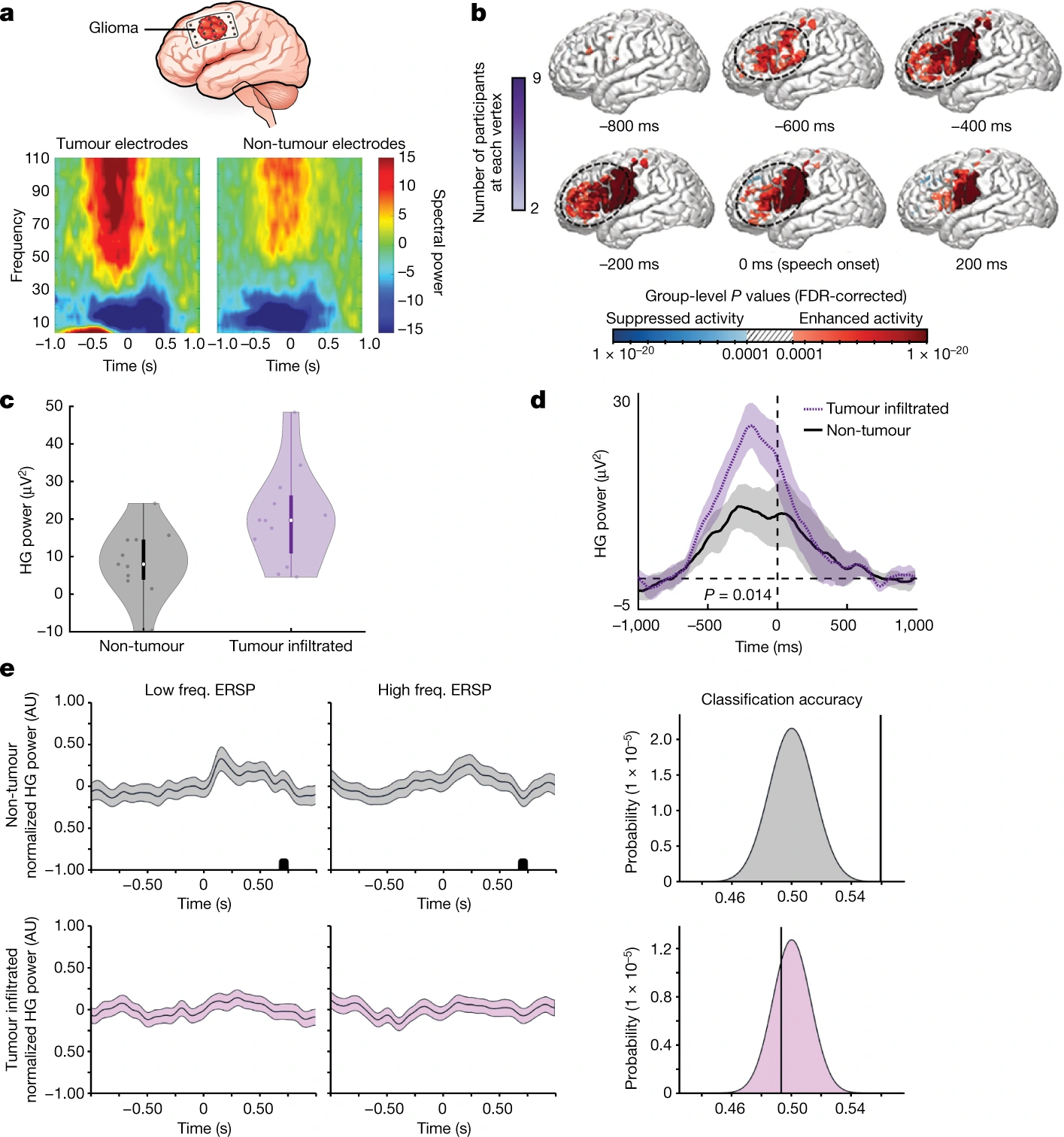
External research: Krishna et al. (2023), Figure 1, studies neural-circuit activity in participants with high-grade glioma. The complete original panels are retained. These observations are not NEUVIOR results or evidence that a NEUVIOR intervention preserves function.
Krishna, Saritha; Choudhury, Abrar; Keough, Michael B.; Seo, Kyounghee; Ni, Lijun; Kakaizada, Sofia; Lee, Anthony; Aabedi, Alexander; Popova, Galina; Lipkin, Benjamin; Cao, Caroline; Nava Gonzales, Cesar; Sudharshan, Rasika; Egladyous, Andrew; Almeida, Nyle; Zhang, Yalan; Molinaro, Annette M.; Venkatesh, Humsa S.; Daniel, Andy G. S.; Shamardani, Kiarash; Hyer, Jeanette; Chang, Edward F.; Findlay, Anne; Phillips, Joanna J.; Nagarajan, Srikantan; Raleigh, David R.; Brang, David; Monje, Michelle; Hervey-Jumper, Shawn L. · A tumour changes the surrounding circuitCC BY 4.0 | Inspect the complete figure
Source and image notes
Faithful proportional viewing copy in WebP; complete original figure and all panels retained. No crop, colour adjustment, relabelling, animation or added data.
Biomedical research | Choosing a revealing comparison
Which missing connection would change the biological explanation?
A tumour marker, a surviving cell and a later recurrence can belong to the same story without establishing the links between them. Inspect five connected questions to see what a proposed biological study would need to explain, and why a result about the tumour must be interpreted alongside the surrounding neural system.
Editorial decision model, not measured NEUVIOR results. Spatial positions indicate relationships, not measured quantities.
A named population needs a demonstrated role.
Concentrating on malignant identity and contribution helps distinguish an interesting description from a causal development hypothesis. A useful first study could fail by finding that the marker does not persist or that the population is not required for regrowth. Either finding would change the next experiment.
Identify the comparison that could overturn the proposed causal role.
Malignant identity
Before interpreting a response, establish what the observation identifies. A malignant-cell label, a temporary state marker and a measure of viability answer different questions. A study needs to describe which population each measurement can recognise and when that recognition becomes uncertain.
- Defines the population
Model identity, marker behaviour and the treatment history of the sampled population.
A useful next stepWhich identity measurement would remain interpretable during recovery?
A useful collaboration closes a consequential biological gap rather than adding an isolated positive assay.
Watch neural processes cross a physical boundary
Neurons growing through a microfluidic device make the model’s physical constraints visible. The film gives collaborators something concrete to question: which cells can move, which structures can cross, and whether that experimental boundary resembles the biological question being asked.
Neurons occupy one channel while processes extend through narrow connecting tunnels. This is external experimental microscopy, not a NEUVIOR model or a patient outcome.
Peter D. Jones, Beatriz Molina-Martínez, Anita Niedworok and Paolo Cesare · Watch neural processes cross a physical boundaryCC BY 4.0 | Original research and methods
Source and image notes
H.264 viewing copy; complete frame retained with proportional downscaling where required; no colour enhancement, crop, speed change or added frames. Audio omitted; original source remains linked.
Follow the boundary
Distinguish a cell body from its extending processes; the device constrains their movement differently.
Ask what the model excludes
A channel isolates parts of the system. The next useful question is which signalling, matrix and neighbouring-cell effects remain unrepresented.
Judge what happens after the immediate response.
An early reduction in cells can be informative, but recurrence research also asks what happens later. Which populations remain? Can regrowth resume? Does altering one population change the behaviour of another? These questions connect an immediate response with the purpose of the programme.
A useful design would consider the period after an intervention as well as the initial measurement. It would define what different outcomes mean and whether the comparison can distinguish the proposed mechanism from other explanations. That helps a finding guide the next commitment.
One field. Different cell states.
Banu et al. (2024) compared engineered mouse gliomas with different cell states. One model contained a quieter, astrocyte-like transformed population; the other was dominated by proliferating progenitor-like states.
The sharper question is what each state depends on to survive. Explore the signals in the published figure, then follow how the study investigated sensitivity to GPX4 inhibition. The research connects cell identity with a specific experimental vulnerability.
Keep the surrounding neural system in view.
A future therapeutic approach would have to operate in the brain, where normal function matters. Selectivity, exposure and the behaviour of relevant neural systems belong in the development question from the beginning.
For our programme, this means examining a possible intervention alongside the functions it needs to preserve. Model choice, appropriate comparators and interpretable functional measurements help make that question more concrete. The goal is a rationale that accounts for the intended biological effect and the context in which it would have to be useful.
NEUVIOR Data Analysis
A source.
A question.
A clearer decision.
Useful intelligence keeps its evidence attached.
Our public analysis connects a defined question with named sources, reporting periods and methods. Each source below shows the work available today and the access still needed.
Published-data analysis, research hypotheses and evidence studies are distinct kinds of work. Their meaning should remain clear as the programme grows.
Open Targets | Quarterly platform releases
Open Targets Platform
Which published associations support a research hypothesis, and through what evidence?
Source identifiedUS National Library of Medicine | Source records updated by responsible parties; API refresh is source-controlled
ClinicalTrials.gov public study records
Which GLIO study designs and eligibility patterns merit scientific review?
Analysis availableLet lived experience inform the purpose.
Communication, independence, everyday function and treatment burden can shape what a useful benefit would mean to people living with a disease. Patient and caregiver involvement can help researchers ask better questions about those priorities.
We are developing involvement alongside the scientific programme. The UK Standards for Public Involvement provide a useful reference for inclusive opportunities, working together, communication and the difference involvement makes. It is a way to improve research choices and understanding, with a clear purpose and suitable support for contributors.
A structure, revealed.
A closer view. A question worth testing.
Human deoxyhaemoglobin, PDB 4HHB (Fermi et al., 1984). A published reference protein, shown through original camera and lighting motion around fixed molecular geometry.
Film creditsBring the right expertise to a focused programme.
Current work centres on scientific design, model and candidate assessment, specialist discussions and involvement planning. Methods that clarify malignant-cell identity, causal regrowth or neural function can each make a defined contribution.
The collaboration question is what a first piece of work would establish, which resources it needs and how it informs the programme’s next decision. Scientific ambition becomes more useful when the comparison, responsibility and development path are clear. Public updates should connect released outputs with that purpose without disclosing confidential methods or unpublished findings.
Which method could make the next biological question answerable?
We welcome clearly scoped research contributions to the initial glioblastoma programme and the scientific questions that shape it.
Sources and further reading
Questions with a destination
Find your way
into the work.
Begin with the contribution you could make. Explore one research question, the evidence it needs and the decision it could inform.
10 questions to explore · In view: Evidence review quality

Evidence & judgement · 1 of 10
Evidence review quality
Explore a proposed medicines evidence study comparing source fidelity, review quality and total checking effort, with a clear decision for research partners.
Explore this research questionAll research questions, by title · 10
- Evidence review quality
- Implementation research
- Reproducible medicines analysis
- Academic and commercial translation
- Research design for smaller businesses
- AI and professional judgement
- Cell states and treatment resistance
- Formulation feasibility research
- Industrial measurement research
- Public involvement in research















