
Intelligent operations should make scientific work more useful
Automation is valuable when it improves a task that matters. A repeated handling step, an awkward information handover or a process question may be a stronger starting point than a demonstration chosen for its visual impact.
NEUVIOR is scoping intelligent operations across laboratory automation, scientific AI and process modelling. The interest is practical: where could a bounded use of technology improve repeatability, interpretation or the organisation of work? These are proposed research and capability directions, with the people responsible for the task helping define the comparison and the result worth pursuing.
Start with the work and its baseline
A useful brief identifies the current task, its users and the consequence of a mistake. It should also establish the full work involved today, including preparation, checking, exceptions and recovery. That creates a realistic comparison for an assisted approach.
The intended benefit needs to be specific. A faster intermediate step may add checking elsewhere; a more consistent handling step may create a different support requirement. An evaluation should examine the complete task. This connects intelligent operations with NEUVIOR’s wider interest in making evidence and implementation useful, while keeping scientific automation distinct from PHARMORIS’s medicines-workflow proposition.
Autonomous laboratories
Our future laboratory-automation interest concerns selected repeatable operations and bounded sequences. A proposed study could examine how identified samples move through a task, how exceptions are recognised and how a competent person returns the system to a safe state.
Consider a hypothetical repetitive handling task. The comparison should include preparation, identity checks, interruptions, cleaning and the effort required when the task fails. That is how a team can judge whether automation is worthwhile in its setting. A closed loop also needs a defined scientific objective and limits on the changes it may make. Human authority remains part of the research design.
Scientific AI
A scientific model should be assessed against the question it will be used to answer. Training performance alone cannot show how it will behave on new material, missing inputs or an unfamiliar operating condition.
A proposed evaluation should examine relevant independent data, uncertainty, errors and the effect on the people using the output. EMA’s adopted AI reflection paper provides medicines-lifecycle context for those questions. For NEUVIOR, the useful research direction is to compare a model with an appropriate existing approach and establish where it deserves further development. Model novelty and a polished interface are insufficient reasons to rely on an output.
One experiment has several operational views
Bai and colleagues show the same reaction through chemistry, experimental data, hardware availability and a knowledge graph. The complete external illustration makes an information handover tangible; it does not demonstrate that an installed NEUVIOR system can perform the workflow.
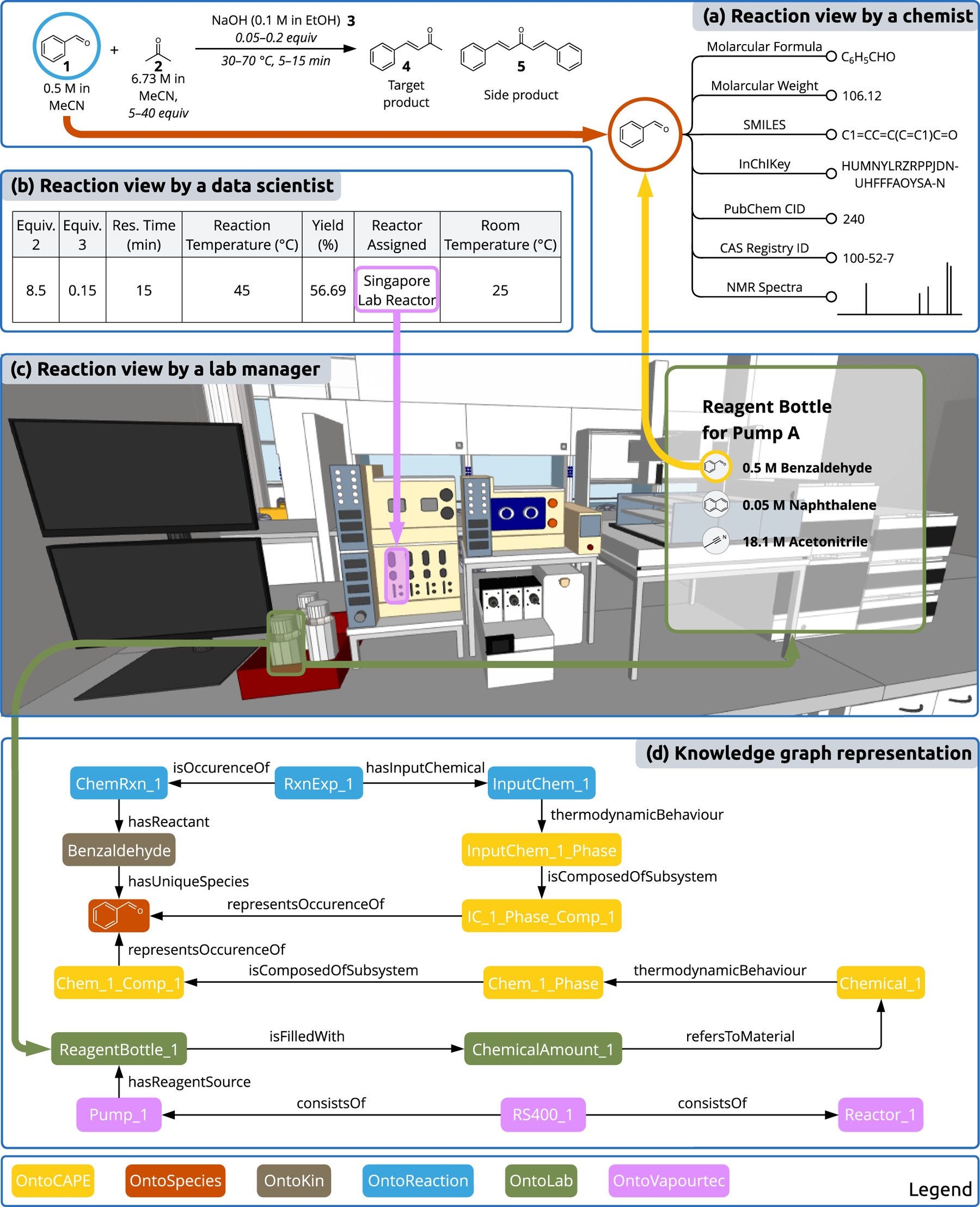
External published system illustration: Bai and colleagues connect chemist, data-scientist, lab-manager and knowledge-graph views of a reaction (2024, Figure 4). The representation belongs to their distributed laboratory study and is not NEUVIOR software, installed automation or evidence of operating benefit.
Bai, Jiaru; Mosbach, Sebastian; Taylor, Connor J.; Karan, Dogancan; Lee, Kok Foong; Rihm, Simon D.; Akroyd, Jethro; Lapkin, Alexei A.; Kraft, Markus · One experiment has several operational viewsCC BY 4.0 | Inspect the complete figure
Source and image notes
Complete figure retained; proportionate resize from 2001×2465 to 1800×2217 pixels using Lanczos resampling; lossless WebP encoding. No cropping, relabelling, recolouring or panel removal.
Intelligent operations | The whole task matters
Where does the work go when the system struggles?
A faster normal run can move effort into checking, exceptions or recovery. Inspect the whole task to see what a proposed automation, model or connected process would need to improve. The useful comparison includes the people responsible for the work and the conditions under which assistance stops being reliable, rather than measuring only a polished demonstration.
Editorial decision model, not measured NEUVIOR results. Spatial positions indicate relationships, not measured quantities.
The demonstrated step is only part of the baseline.
A sponsor can ask whether the proposed system changes a complete task that matters. Counting setup, review and support helps distinguish a useful improvement from a narrow technical speedup. The relevant comparison remains the competent existing approach under the actual intended conditions of use.
Define the whole task before choosing an automation metric.
Current complete task
The baseline includes preparation, identity checks, ordinary work, interruption and restoration. Without that boundary, a technical demonstration can appear faster while adding effort elsewhere. The proposed brief should identify who currently carries each part of the work and why a mistake matters.
- Defines the purpose
- Revises the operating comparison
A task definition with the full competent existing workflow and its exceptions.
A useful next stepWhich part of the present task repeatedly creates avoidable difficulty?
A worthwhile intelligent-operation study accounts for the work created around the assisted step.
Automation is visible in the handovers between samples
The useful question is what happens between nominally identical runs. This published automated worm-delivery sequence shows fluid routing and switching as part of the experiment, helping a laboratory buyer ask about carry-over, timing, recovery and the evidence needed to trust a repeated operation.
A published real-time sequence delivers C. elegans populations from sixteen wells through a microfluidic multiplexer. The organisms and protocol belong to the original study.
Ghorashian N, Gokce S, Guo S, Everett W, Ben-Yakar A · Automation is visible in the handovers between samplesCC BY 2.5 | Original research and methods
Source and image notes
H.264 viewing copy; complete frame retained with proportional downscaling where required; no colour enhancement, crop, speed change or added frames. Audio omitted; original source remains linked.
Follow the switch
The transport route changes between populations; that handover deserves its own evidence, not just a nominal throughput figure.
Look beyond movement
Seeing transport does not establish absence of mixing, viability or successful downstream analysis; those require the original measurements.
Digital twins
A process model can help explore scenarios before changing a physical operation. Its usefulness depends on which relationships it represents, the information available and whether its predictions have been tested for the intended question.
For a future model connected to operating data, synchronisation, data quality and change become part of the problem. Connection alone does not make a model trustworthy. A focused study could compare selected predictions with observed behaviour and examine where the model becomes unreliable. Our interest is in decision value: whether the model helps a team understand a process, plan an investigation or avoid an unsuitable commitment.
People, exceptions and recovery
An intelligent system needs people who understand what it is intended to do and what to do when it behaves unexpectedly. Review, escalation, stopping and recovery should be designed around the actual task and its consequences.
A worthwhile evaluation examines those moments as well as normal operation. Can the user recognise an error? Is the relevant information available? What work is required to resume safely? Changes to data, software, suppliers or equipment may also alter performance. These questions help turn an appealing technical idea into a more assessable proposition for the organisation expected to operate it.
Access the expertise around the system
An automation project brings together more than hardware or software. Scientific knowledge, engineering, data expertise, human factors and operational experience may all be needed for a focused comparison.
Specialist access can be a useful route while the task and demand are being established. Ownership may make sense where repeated work and a capable operating team justify the continuing commitment. The comparison needs to include integration, support, interruptions and the cost of maintaining useful performance. NEUVIOR’s capability planning puts that whole operating question alongside the technical idea, with future facilities shaped by a credible reason to use them.
Bring a task worth improving
We welcome researchers, development teams and industrial organisations with a specific scientific or operational task that might benefit from automation or modelling. Tell us the current process, the people responsible and the part that repeatedly creates difficulty.
We can explore the proposed research question, suitable specialist input and an evaluation that would make the next decision clearer. A focused case with a useful baseline is a stronger beginning than an open-ended request for an autonomous laboratory. The ambition is to develop technology around scientific work that people have a real reason to improve.
Continue the programme
- Autonomous Laboratories & Closed-Loop Discovery
Read about autonomous laboratories & closed-loop discovery at NEUVIOR, the evidence behind the work, and the decisions required for its next stage.
- Scientific AI & Model Governance
Read about scientific ai & model governance at NEUVIOR, the evidence behind the work, and the decisions required for its next stage.
- Digital Twins & Cyber-Physical Operations
Read about digital twins & cyber-physical operations at NEUVIOR, the evidence behind the work, and the decisions required for its next stage.















