
Scientific AI & Model Governance
Judge models by context, uncertainty and consequence, not novelty.
Status: Proposed capability · subject to evidence gates
Current boundary: Illustrative proposed experiment envelope. This is not performed work, a protocol, an installed capability, a service offer, a validated method or evidence of an operating laboratory. No GMP, GLP, manufacturing-licence, clinical or regulatory-readiness status is claimed.
Technical explanation
• A proposed scientific-AI environment could evaluate models used for experimental prioritisation, spectral interpretation, anomaly detection, process prediction or operational decision support against a declared context of use.
• Evaluation would cover provenance, leakage, calibration, uncertainty, subgroup or domain performance, distribution shift, adversarial or missing inputs, human factors and retirement. Statistical performance alone would not establish scientific validity or regulated acceptability.
In everyday terms
• AI can find patterns, but a confident answer can still be wrong. The important questions are what data the model saw, where it fails and who remains responsible.
• The proposed programme would challenge a model before it is trusted and keep people able to override, pause and retire it.
Published research · A closer reading
A model score is one part of the experiment.
This complete published figure connects an image-processing network to laboratory instructions. Read the probability map, thresholded cell positions and physical action separately: a strong curve is not, on its own, assurance for every sample or instrument.
External cell-imaging and microfluidics research. The representative images have an original 100 µm scale bar; evaluation scores are task- and dataset-specific.
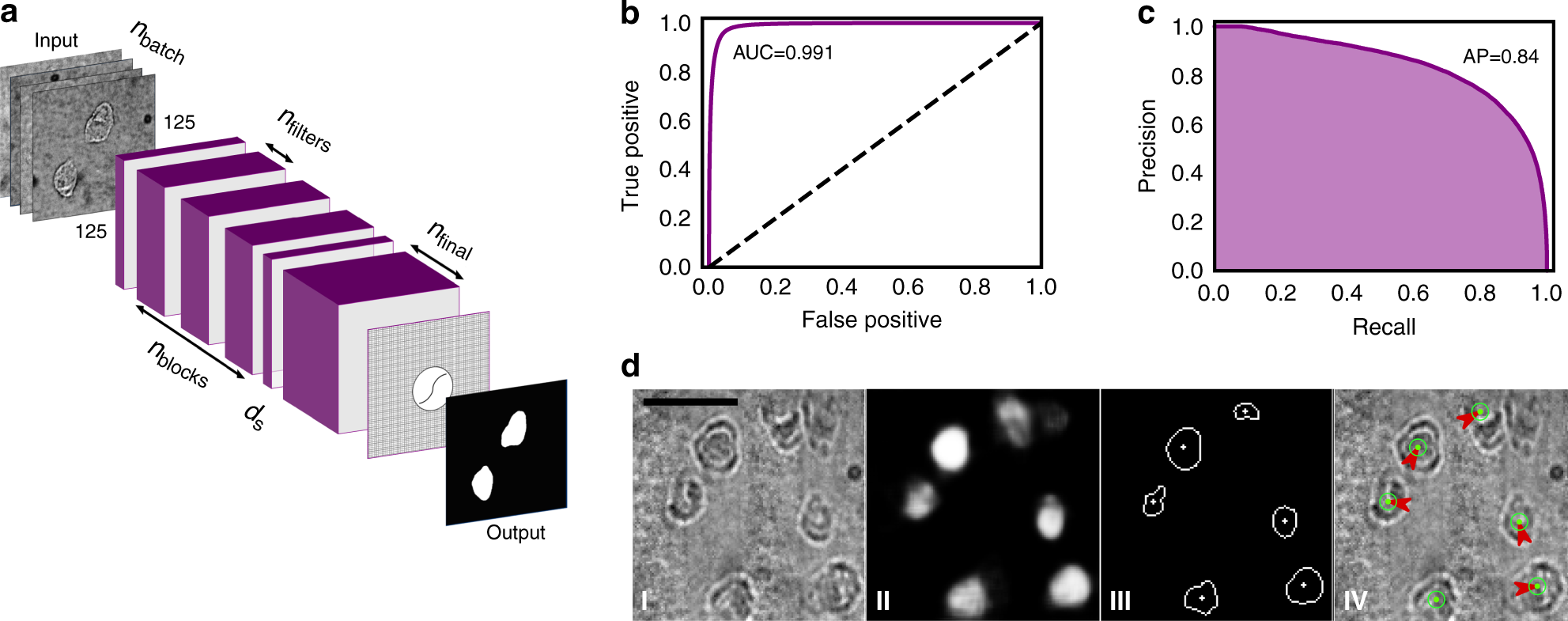
Lamanna et al. (2020), Figure 2. The DISCO study reports a convolutional network for cell localisation, ROC and precision–recall curves, representative post-processing and vector instructions for laser cell lysis. The reported AUC 0.991 and average precision 0.84 concern this published evaluation, not a NEUVIOR model. Reproduced unmodified under CC BY 4.0.
Illustrative enquiry model
Illustrative locked-challenge model evaluation
Question: Does a model remain calibrated, useful and recoverable when tested on unseen data, missing inputs, domain shift and known failure cases?
Variables
• Dataset and site domain
• Missingness and noise
• Decision threshold
• Model and preprocessing version
Observations
• Discrimination and calibration
• Conformal or other uncertainty coverage
• Error severity by declared subgroup or domain
• Human review and override performance
Controls
• Locked independent challenge set
• Simple baseline model
• Predeclared metrics and acceptance limits
• Leakage, shift and provenance audit
Decision informed: Restrict the context, require new evidence, retain a simpler method or stop deployment.
Scientific model and assumptions
Calibration and uncertainty coverage
Model: Brier = N^(-1)Σ(pᵢ - yᵢ)² · P{Y ∈ C(X)} ≥ 1 - α
Assumptions
• Outcomes and sampling process are appropriate for the stated context
• The challenge set is independent and representative enough for the claim
• Coverage assumptions and exchangeability limits are disclosed
Interpretation: The Brier score measures probability error. Conformal coverage describes one uncertainty guarantee under specific assumptions; neither proves causality, fairness or safe use outside the tested domain.
Indicative equipment and dependencies
Secure scientific data enclave
Role: Separate governed data development, challenge and approved-use environments.
Dependencies
• Lawful data rights
• Role-based access
• Retention and deletion controls
Versioned model registry
Role: Preserve model, feature, code, dependency and approval state.
Dependencies
• Named owners
• Change control
• Rollback and retirement route
Independent challenge harness
Role: Execute locked performance, shift, missingness and robustness tests.
Dependencies
• Predeclared plan
• Baseline comparator
• Protected test data
Explainability and error-analysis workbench
Role: Support domain review of failure patterns without treating one explanation method as truth.
Dependencies
• Scientific reviewer
• Method limitations
• Reproducible analysis
Human-in-the-loop simulation room
Role: Evaluate how users interpret, override and recover from model output.
Dependencies
• Human-factors design
• Representative users
• No live regulated decisions
Data and human authority
Data layer
• Data lineage and lawful-use record
• Model and dependency versions
• Independent test results
• Human decision, override and incident log
Human authority: The scientific owner defines intended use and limitations; data, quality, security and risk owners hold independent stop rights.
Prohibited automation: No model may decide patient care, clinical eligibility, batch release, regulatory compliance or scientific truth, or retrain itself into production without approved change control.
Potential output and stop condition
Potential output: A model-applicability statement covering intended use, evidence, uncertainty, limits, monitoring, human controls and retirement conditions.
Stop gate: Stop when data authority, independent performance, calibration, robustness, monitoring, human understanding or consequence controls are inadequate.
Campus design implications
Constellation is one developing campus concept. Scotland is among the locations under consideration; the programme does not currently present a second committed campus in India or elsewhere.
A capability brief before a location decision
Responsible scientific AI for analytical, robotics, translational and advanced-manufacturing decisions.
Model testing, data engineering and human-governed automation across formulation, quality and transfer workflows.
Design for the chosen site and its users
Secure review rooms and model-test infrastructure physically separated from live laboratory control.
Resilient local compute, secure partner workspaces and explicit boundaries between research and regulated systems.
These are alternative requirements to test against climate, product scope, users and the local operating route. They describe a design brief, rather than installed equipment, available services or an approved building.
The investment question
Could help research and development teams turn promising models into inspectable, bounded evidence.
Could build advanced AI and quality roles around real scientific use cases rather than generic software claims.
Potential users
Type: Medicines and biotechnology developers
Need: Independent challenge of a model used in one development decision.
Proposed deliverable: A context-of-use and model-risk package.
Type: AI and scientific-software companies
Need: Domain-grounded evaluation beyond a product demonstration.
Proposed deliverable: A scoped challenge study without validation or regulatory endorsement.
Type: Universities and data-science teams
Need: A governed path from research model to realistic scientific workflow.
Proposed deliverable: An evidence and failure-mode assessment with rights agreed.
Sustainability questions
Metric: Compute energy per accepted decision
Method: Record training, tuning, inference and storage energy for the defined use case.
Decision informed: Compare model complexity against measurable decision value.
Metric: Avoided experiment burden
Method: Count only experiments demonstrably removed without weakening the evidence gate.
Decision informed: Test whether prioritisation creates real scientific efficiency.
Metric: Model and data retirement
Method: Track inactive versions, duplicated datasets and storage lifecycle.
Decision informed: Prevent indefinite digital accumulation.
Safety and regulatory gates
• Declared context and consequence of failure
• Lawful, representative and traceable data
• Independent challenge and simple baseline
• Uncertainty, shift and cybersecurity testing
• Named human approval, override and retirement rights
• Applicable EMA, FDA, MHRA, CDSCO and data-protection review before regulated use
Sources and scientific attribution
NIST Artificial Intelligence Risk Management Framework 1.0
Source type: Official framework
Relevance: Supports governance, mapping, measurement and management of AI risks across a defined context of use.
Caveat: The voluntary framework is not a validation certificate or sector-specific regulatory authorisation.
Source: https://www.nist.gov/publications/artificial-intelligence-risk-management-framework-ai-rmf-10
EMA reflection paper on AI in the medicinal-product lifecycle
Source type: Official framework
Relevance: Provides lifecycle considerations for AI and machine learning used in medicine development and regulation.
Caveat: The reflection paper does not validate a model or replace product- and use-specific requirements.
FDA artificial intelligence for drug development
Source type: Official framework
Relevance: Collects current FDA principles, guidance and publications for AI in drug development and manufacturing.
Caveat: Regulatory acceptability remains evidence- and context-specific.















