
Manufacturing readiness begins with process knowledge
A promising laboratory result leaves an important question: what would it take to produce the material or product consistently in a practical process? Scale, handling, measurements, packaging and the receiving organisation all affect the answer.
Manufacturing readiness is a capability direction NEUVIOR is scoping around that development task. The aim is to expose process and transfer questions early enough for a business to choose a sensible next step. A focused study, specialist development access or work with a qualified manufacturer may provide more useful progress than committing to a facility before the process is understood.
Process chemistry
For a chemical process, reaction understanding is connected to separation, recovery and the properties of the material produced. A route that looks attractive at one scale may create different demands when conditions or equipment change.
A useful process brief identifies the product question, the relevant operations and the factors that could alter performance. It also considers the knowledge needed to interpret an unexpected result. Our proposed capability interest is in comparing routes and resolving those consequential uncertainties. The next output should help the team choose an investigation, revise the process or prepare a clearer development discussion with a specialist organisation.
Scale changes the question
Increasing quantity can change the behaviour of mixing, heat transfer, timing and handling. A larger vessel is only one part of the scale question. Materials, equipment characteristics and the sequence of operations also influence what a process needs.
Consider a hypothetical transfer from a small research preparation to a larger development study. The team needs to identify which parts of the existing knowledge remain useful and which assumptions deserve testing. The comparison could examine a selected operation, its measurement and its effect on the product. This gives scale work a purpose beyond producing a bigger batch.
Capabilities · Manufacturing and transfer
The line changes. What must stay true?
A different setting changes the interfaces. Make the first transfer question precise before the capacity commitment becomes difficult to unwind.
Explore the decisionClear open glass vials move along conveyor guides. The setting, product status and equipment qualification are not established; this is not a NEUVIOR manufacturing installation.DepictionImages / Envato Elements
Movement is visible. Suitability needs evidence.
Choose where the uncertainty sits. The useful output is a first evidence brief, not a readiness score or an assumed qualified process.
Inspect the interface
A transfer starts with a question.
Choose a perspective. Add the questions you want to discuss. Your brief stays on this device until you choose to share it.
Define the incoming item
The container is part of the interface.
Describe what the receiving operation will handle: the relevant container specification, material attributes and condition. Identify the incoming facts that are confirmed and the ones still assumed.
- The defined input
- A specific container and its relevant handling or quality attributes.
- The evidence gap
- Which incoming attribute could change the receiving operation’s assumptions?
Your discussion brief
0 questions selectedNotes remain in this page. Nothing is sent or saved to a server. Selected questions are prompts, not evidence supplied.
A visually similar container does not establish equivalent behaviour in a receiving process.
Prepare the first study, not the final verdict.
Sources, method and film credit
This is an editorial discussion aid. It does not specify operating values, qualify a line or establish product quality. Use the relevant current quality framework and receiving organisation’s authorised procedures for the actual process.
The process-validation context comes from FDA (2011); the proposed discussion structure is NEUVIOR editorial interpretation.
Film: DepictionImages / Envato Elements commercial licence. Clear open glass vials move along conveyor guides. The setting, product status and equipment qualification are not established; this is not a NEUVIOR manufacturing installation. Poster images are frames from the same film, not additional original images.
A specific question. A useful next conversation.
Make the first study matter.
Discuss a transfer questionControl, quality and the receiving organisation
Process knowledge should connect materials and operating conditions with the product features that matter. The team needs a clear account of what is measured, which changes require attention and who is responsible for interpreting the result.
Future manufacturing activity must be planned around the product, the operator and the appropriate quality and legal scope. A development study and licensed commercial manufacture carry different responsibilities. Our manufacturing-readiness direction concerns the evidence needed to make those later choices well. It does not assume that a proposed process has been qualified or that NEUVIOR operates an authorised manufacturing site.
Transfer includes the interfaces around the vessel
Feng and colleagues connect pumps, valves, a reservoir, separation and monitoring in one external apparatus schematic. These interfaces support a concrete transfer discussion, while the research system remains separate from process qualification or licensed manufacture.
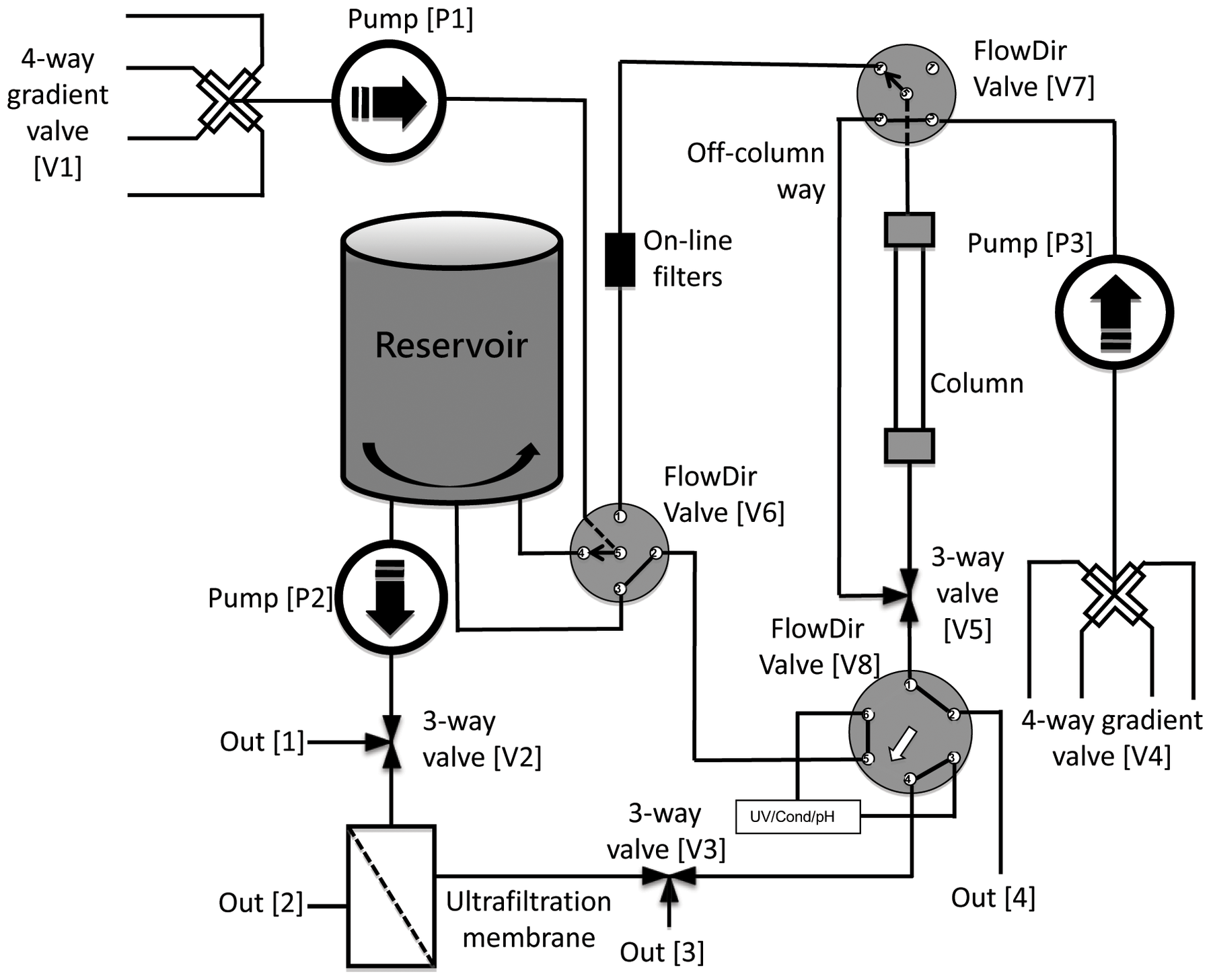
External published apparatus schematic: Feng and colleagues’ automatic protein-refolding system (2012, Figure 1). Its labelled equipment and recovery routes belong to the reported experimental system, without establishing a qualified NEUVIOR process or manufacturing authorisation.
Yanye Feng; Ming Zhang; Linlin Zhang; Ting Zhang; Jianfeng Ding; Yingping Zhuang; Xiaoning Wang; Zhong Yang · Transfer includes the interfaces around the vesselCC BY 4.0 | Inspect the complete figure
Source and image notes
Complete figure retained; proportionate resize from 1824×1476 to 1800×1457 pixels using Lanczos resampling; lossless WebP encoding. No cropping, relabelling, recolouring or panel removal.
Manufacturing readiness | Find the fragile transfer assumption
Which process assumption will break when the setting changes?
Producing more material does not simply enlarge the laboratory experiment. Equipment, heat transfer, separation and the receiving organisation can change the question. Inspect the interfaces to identify which assumption deserves a focused study before a transfer or capacity commitment. The drawing is a proposed reasoning model, not a qualified process or an operating NEUVIOR manufacturing service.
Editorial decision model, not measured NEUVIOR results. Spatial positions indicate relationships, not measured quantities.
Target the assumption that scale or equipment may change.
A technical brief should connect the material, operating behaviour and recovered product. It does not need to fund every possible study at once. The useful first comparison is the one capable of exposing a failure that would otherwise appear only after a larger transfer commitment.
Choose one operation and its highest-consequence untested assumption.
Material behaviour
The transferred process begins with materials whose relevant attributes need to be understood. A familiar chemical name may conceal differences in particle form, impurities, handling or storage history. The receiving team needs the attributes that matter to the particular process, not an unqualified claim of equivalence.
- Changes the operating question
The product question, material attributes and actual history of the inputs.
A useful next stepWhich material difference could change the operation being transferred?
A focused transfer study can make the next manufacturing discussion clearer before capital or scale magnifies the uncertainty.
A process step needs more than a successful appearance
A transfer discussion should expose what must be controlled, measured and repeated. This published on-column BSA-refolding demonstration gives process teams a defined reference for discussing operation order, material behaviour and the separate evidence needed to demonstrate an accepted output.
Published animated process schematic of on-column BSA refolding in an automatic refolding apparatus. The animation is a method illustration, not filmed manufacturing or a NEUVIOR production line.
Feng Y, Zhang M, Zhang L, Zhang T, Ding J, Zhuang Y, Wang X, Yang Z · A process step needs more than a successful appearanceCC BY 2.5 | Original research and methods
Source and image notes
H.264 viewing copy; complete frame retained with proportional downscaling where required; no colour enhancement, crop, speed change or added frames. Audio omitted; original source remains linked.
Follow the operation
Follow the labelled valves and flow paths in this animated process schematic; their order describes the proposed operation rather than measuring process performance.
Define accepted output
Recovery, folding, activity, impurity profile and repeatability need measurements beyond the film.
Resource performance
Yield is one part of process value. Solvent, water, energy, waste, recovery and the demands of maintaining product performance can change the comparison between routes. Those measures should share a clearly defined product and process boundary.
For example, a hypothetical recovery step might reduce demand for one input while adding treatment, separation or quality-checking work. A useful comparison counts those consequences together. Resource Economics brings that broader question into NEUVIOR’s portfolio. The aim is to identify changes worth developing through measured performance and practical economics, with environmental benefit established by the relevant evidence rather than inferred from a novel material or process.
Make the transfer package useful
A receiving development or manufacturing organisation needs to understand the process and the knowledge behind it. Relevant material attributes, operating conditions, analytical methods, handling requirements and unresolved risks should be connected to the proposed product.
The transfer discussion can then focus on equipment fit, specialist expertise, training and the work required to establish reliable performance in the receiving setting. A strong package makes gaps easier to identify and cost. It helps an SME or research team have a more productive conversation about the next stage, with the responsibilities of both organisations clear.
Owned capacity or accessed capability
Ownership brings control over scheduling and an enduring commitment to staff, maintenance, utilities, quality and operating continuity. Access to specialist process-development capability can suit a programme whose demand or technical route is still being established.
A qualified external manufacturer may also remain the strongest long-term route for a particular product. The choice should follow demand, process knowledge, delivery needs and the full economics of each model. NEUVIOR’s proposed campus thinking sits within that comparison. A facility should answer a credible industrial need and earn its place through a viable operating model.
Shape the next process decision
We welcome development businesses, researchers and industrial teams with a process question that affects scale, transfer or resource use. The starting point is the material or product, the existing process knowledge and the decision that a study must support.
Tell us which operation creates uncertainty, what evidence is available and what a receiving organisation would need before progressing. We can discuss the research direction, specialist capability and scope of a comparison that makes the next investment more assessable. A useful manufacturing-readiness brief turns ambition into a process question someone can investigate.















