
What the work can establish
A research output should make clear what was investigated, how it was examined, and what can reasonably follow from the result.
Our programme development is organised around questions in medicines implementation, glioblastoma recurrence, pharmaceutical materials, and energy performance. This page connects those questions with the methods and outputs that become available.
Read by programme
Medicines Intelligence examines evidence reliability, professional review, implementation, and economic consequences. Biomedical Research begins with malignant-cell survival and regrowth in glioblastoma. Regenerative Economics connects materials and process performance with industrial and environmental evaluation.
Follow the question first
The programme pages explain the current research rationale and the next evidence needed. As outputs become available, their records will identify the authors, date, publication status, and relationship to the relevant programme.
Available data still need to be usable
An open-data statement is only the first part of a reader’s check. This published audit distinguished whether shared files existed, matched the article, could be used and were complete.
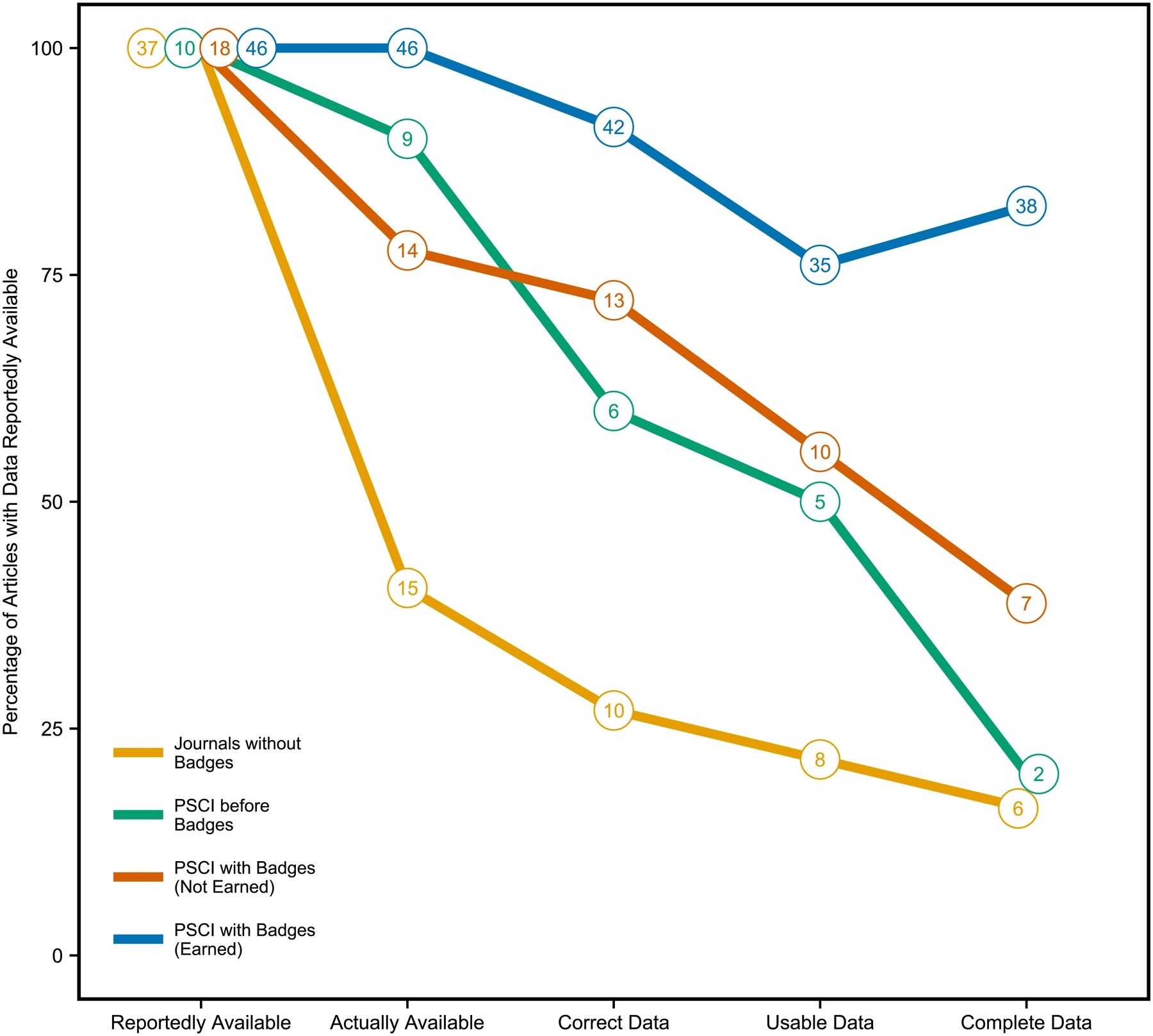
External meta-research: Kidwell et al. (2016), Figure 4, audits data availability, correctness, usability and completeness in the journals examined. The observations concern that study’s sample and comparison; they do not establish the quality or completeness of a NEUVIOR publication.
Kidwell Mallory C.; Lazarević Ljiljana B.; Baranski Erica; Hardwicke Tom E.; Piechowski Sarah; Falkenberg Lina-Sophia; Kennett Curtis; Slowik Agnieszka; Sonnleitner Carina; Hess-Holden Chelsey; Errington Timothy M.; Fiedler Susann; Nosek Brian A. · Available data still need to be usableCC BY 4.0 | Inspect the complete figure
Source and image notes
Faithful proportional viewing copy in WebP; complete original figure and all panels retained. No crop, colour adjustment, relabelling, animation or added data.
Publications and methods | Inspect the record
Can you tell what this research output establishes?
A research output is useful when its identity, status and supporting method are clear enough to inspect. Open the layers of a publication record to distinguish a released document from the evidence behind its conclusions. The same structure can help a collaborator request the missing information without assuming that every listed output has been peer reviewed or independently reproduced.
Editorial decision model, not measured NEUVIOR results. Spatial positions indicate relationships, not measured quantities.
First establish what the document is.
A reader can make a useful first assessment without assuming the strongest publication status. Identifying the actual version and review history prevents an early manuscript or programme note from being presented as an established result. It also makes a later correction easier to recognise and trace.
Locate the version and its stated release or review status.
Document identity
A title alone cannot distinguish versions or establish who is responsible for a document. The record should connect authors, date, identifier where available and the specific version being discussed. A later revision may change the interpretation without changing the familiar headline.
- Locates the actual record
The exact document, authorship, version and publication or repository identifier.
A useful next stepCan another reader locate the same version you are interpreting?
A clear research record lets the reader inspect the claim without upgrading its publication status.
Protein handling becomes visible over an experimental time course
A methods library should let readers see what an observation actually contains. This published bacterial protein-folding time-lapse illustrates the value of retaining strain, induction, fluorescent reporter and acquisition schedule alongside a visual result rather than extracting a free-standing claim.
Published DnaK-mCitrine imaging in a mycobacterial strain with induced mCerulean-ELK16 expression. This is bacterial cell biology, not a therapeutic-protein formulation experiment.
Fay A, Glickman M · Protein handling becomes visible over an experimental time courseCC BY 4.0 | Original research and methods
Source and image notes
H.264 viewing copy; complete frame retained with proportional downscaling where required; no colour enhancement, crop, speed change or added frames. Audio omitted; original source remains linked.
Keep the reporter explicit
Fluorescence reports the labelled construct under these conditions; it does not quantify every folding event in the cell.
Inspect the acquisition history
The original time spacing and growth conditions are essential to interpreting a condensed movie.















