
GPX4 and ferroptosis in glioblastoma research
GPX4 is an enzyme that helps protect cells from damaging oxidation of membrane lipids. When this protection becomes insufficient, cells can undergo ferroptosis, a form of cell death involving iron-dependent lipid damage. Researchers are examining whether some glioblastoma cells depend especially strongly on this protective system. Banu et al. (2024); Hambright et al. (2017)
The central challenge is selectivity: can the tumour be affected at an exposure that normal brain tissue can tolerate?
What the glioblastoma study found
A 2024 study reported that glioblastoma cell state influenced vulnerability to disruption of GPX4-dependent protection. The researchers used genetically engineered mouse tumour models, cultured cells, a human glioblastoma cell line, and short-term human tumour slices. They combined molecular measurements with genetic and pharmacological experiments. Banu et al. (2024)
This matters because it moves the question beyond whether a gene is simply present. A cell can express a protein without depending on it in the same way as another cell.
The findings also depended on experimental context. Some state-associated features changed during culture. Inhibiting another metabolic process could alter the response to GPX4 inhibition. These observations make biological context part of the hypothesis, rather than a detail to ignore. Banu et al. (2024)
What remains unresolved
The study does not show that all glioblastomas share this vulnerability. Its human-slice experiments were short, involved six specimens, and included an IDH-mutant astrocytoma as well as glioblastomas. They cannot establish durable prevention of regrowth, delivery throughout an infiltrating tumour, or safety in people. Banu et al. (2024)
Nor does the study directly establish that cells surviving the usual combination of radiotherapy and temozolomide become selectively GPX4-dependent. That proposed treatment sequence needs its own evidence.
A reduction in cell viability becomes more convincing evidence of ferroptosis when several independent findings agree, including appropriate rescue experiments and genetic evidence. Even then, identifying the mechanism of cell death does not establish an acceptable treatment.
Why protecting the brain is essential
A 2017 mouse study removed Gpx4 genetically from forebrain neurons. The animals developed cognitive impairment and neurodegenerative changes over time. An early assessment did not reveal every later effect. Hambright et al. (2017)
This is a meaningful warning about normal-neuron biology. It is not a measurement of a safe dose for a drug: genetic loss in a mouse and a controlled drug exposure are different interventions.
The implication for development is that delayed effects matter. Researchers would need to assess normal neural tissue alongside tumour models, measure relevant exposure, and examine function as well as cell survival. A tumour response would not compensate automatically for unacceptable neurological injury.
Published research · A closer reading
The same mechanism can have different consequences.
A separate study by Yee and colleagues found that GPX4 overexpression or ACSL4 depletion reduced necrosis and aggressiveness in an engineered mouse xenograft setting. This contrasting result matters: ferroptosis can contribute to tumour progression in a particular system. It is a different experiment from the state-specific dependency discussed earlier, and neither result establishes a treatment for patients.
Panels a–f: engineered LN229/TAZ(4SA) xenografts in immunodeficient mice. Later panels include separate human-dataset associations; mouse survival is not a human outcome.
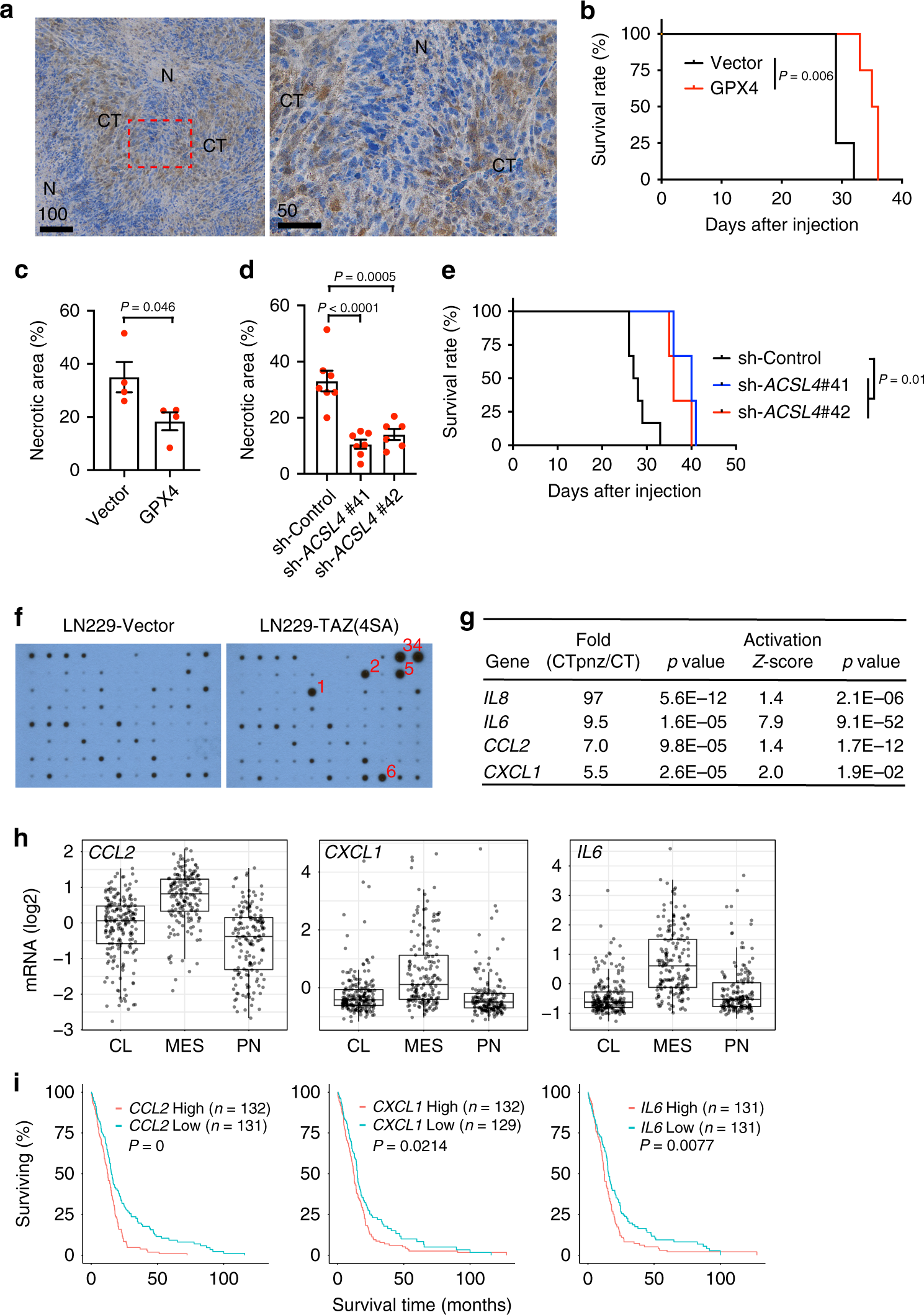
Why context matters | In this engineered mouse xenograft model, GPX4 overexpression or ACSL4 depletion reduced tumour necrosis and aggressiveness. The result illustrates a pro-tumour role for ferroptosis in this setting; it does not establish a GPX4 treatment for patients. Yee et al. (2020), Figure 6 | CC BY 4.0. Reproduced unmodified.
Questions for a proposed medicine
A GPX4-directed programme needs to determine which tumour cells are dependent on the pathway, whether that dependency persists after clinically relevant treatment, and whether affecting those cells reduces later regrowth.
It must also establish how an intervention reaches dispersed tumour cells and how long the exposure lasts. Local delivery may change exposure, but proximity to the tumour does not by itself prove coverage or neural safety. Clinical neuro-oncology and radiobiology both make normal-tissue effects central to treatment design. Wen et al. (2025); Hall and Giaccia (2019)
GPX4 is therefore a research rationale with important unresolved conditions. The published studies do not establish an effective or safe GPX4 treatment for glioblastoma patients.
Three claims that need different evidence.
Expression asks whether a molecule or signature is detected. Dependence asks whether a cell needs a pathway under defined conditions. Therapeutic usefulness asks whether intervening produces a meaningful, tolerable and deliverable benefit. A result can support one of these claims without supporting the next. The distinction helps explain why a strong molecular image or a reduction in an assay signal is an opening to further work rather than the final development argument.
A proposed experiment should make those steps visible. If a perturbation changes the response, independent mechanism evidence can help examine why. Following recovery and regrowth asks whether the effect lasts. Comparing measured exposure and neural function asks whether there is a useful separation between intended activity and harm. These are public measurement principles, not a disclosure of a proprietary candidate or a validated NEUVIOR treatment.
The practical opportunity for a collaborator is to strengthen one uncertain link with a suitable method. That contribution can be valuable even when it redirects or rejects the original target rationale.
What this means for our research
GPX4 is one candidate dependency. It would advance only if mechanism, durable regrowth, relevant exposure and normal neural function support the same development decision.
NEUVIOR's reviewed programme record describes research design and evidence synthesis. Explore the programme.
Questions to take away
• Does the candidate affect later regrowth as well as early viability?
• Was normal neural function assessed over a relevant recovery period?
• Does measured exposure reach the infiltrating cells?
Educational editorial draft | Scientific and clinical review pending.