
Glioblastoma treatment and supportive care
Glioblastoma treatment aims to control the tumour whilst preserving function and quality of life. The plan depends on the tumour, the person's health and neurological function, molecular results, previous treatment, and preferences. A treatment useful for one person may be unsuitable for another. Wen et al. (2025); Batchelor and Weller, eds (2025)
Surgery
Surgery can provide tissue for diagnosis and remove tumour. The aim is to remove as much as can be removed safely.
Because glioblastoma can infiltrate functioning brain, removing the visible mass does not necessarily remove every malignant cell. Techniques used to guide surgery help clinicians manage the balance between resection and neurological function. Some tumours or patient circumstances allow only a biopsy or a more limited procedure. Wen et al. (2025); Batchelor and Weller, eds (2025)
Radiotherapy and temozolomide
Radiotherapy uses ionising radiation to damage tumour cells and reduce their capacity for continued growth. Temozolomide is an alkylating chemotherapy. For suitable patients, radiotherapy with temozolomide during and afterwards remains a central treatment approach described in the 2025 SNO and EANO consensus. Age, function, MGMT status, and tolerability influence how that evidence is applied. Wen et al. (2025)
The landmark 2005 trial compared radiotherapy alone with radiotherapy plus concurrent and subsequent temozolomide. It randomised 573 patients, aged 18–70, with specified performance and organ-function requirements. Stupp et al. (2005)
Median overall survival: Radiotherapy alone 12.1 months; Radiotherapy plus temozolomide 14.6 months. Stupp et al. (2005)
Survival at two years: Radiotherapy alone 10.4%; Radiotherapy plus temozolomide 26.5%. Stupp et al. (2005)
These figures describe the enrolled groups. A median is not a prediction of how long one person will live, and the difference between medians is not an amount gained by every patient. The trial also predates modern molecular classification. Stupp et al. (2005)
The study tested the combined treatment strategy. It did not determine the separate contribution of concurrent and later chemotherapy or show that more cycles always produce greater benefit.
Other treatments and recurrence
Tumour-treating fields are discussed in international clinical literature for selected patients, but recommendations and access differ between health systems. NICE guideline NG99 currently advises against offering them for newly diagnosed grade 4 glioma or recurrent high-grade glioma. The treating team can explain the guidance and availability that apply locally. Wen et al., 2025; NICE NG99, recommendations 1.2.26 and 1.2.34.
At recurrence, options may include another operation, further radiotherapy, systemic treatment, or a clinical trial. There is no single approach appropriate to everyone. A trial's relevance depends on its actual eligibility, location, recruitment status, and the clinical situation. Wen et al. (2025)
Movement and reported wellbeing need their own measures
The study compares wearable-derived movement with patient-reported questionnaire domains. Their relationships make a useful point for a treatment discussion: different aspects of daily life cannot be collapsed into one scan result or one global outcome.
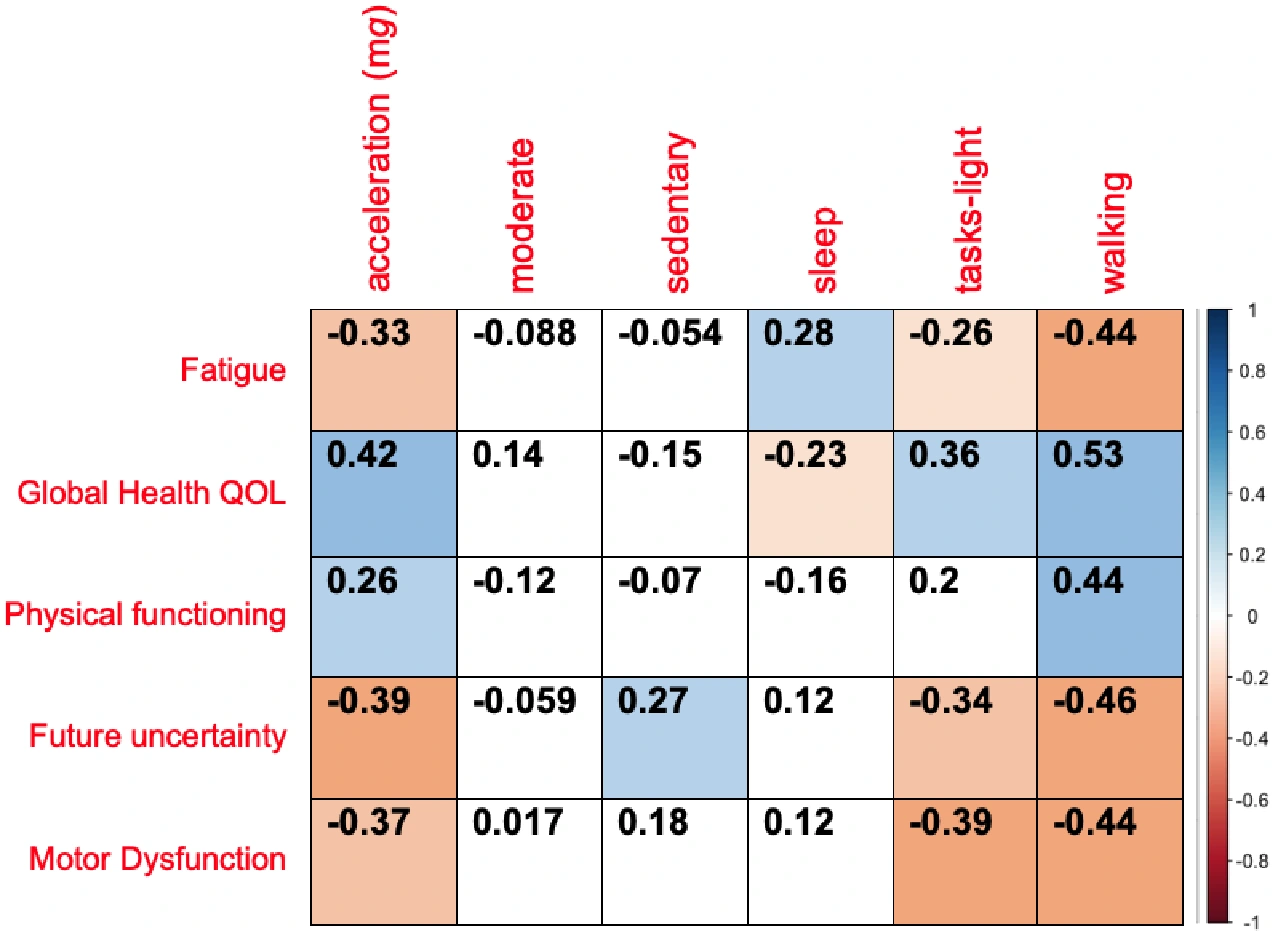
External observational research: Dadhania et al., the BrainWear study (2023), Figure 4, reports correlations between accelerometer-derived behaviours and questionnaire domains in its high-grade glioma cohort. The associations do not establish a treatment effect, individual prediction or NEUVIOR finding.
Dadhania Seema; Pakzad-Shahabi Lillie; Mistry Sanjay; Williams Matt · Movement and reported wellbeing need their own measuresCC BY 4.0 | Inspect the complete figure
Source and image notes
Faithful proportional viewing copy in WebP; complete original figure and all panels retained. No crop, colour adjustment, relabelling, animation or added data.
Treatment evidence | Keep the outcome in view
Which outcome does the treatment headline actually describe?
A study may report an imaging response, later progression, survival, neurological function or treatment burden. Those observations answer different questions. Select an outcome lens to see what must accompany a treatment headline before it becomes informative, and why a laboratory response cannot be substituted for an individual clinical benefit or a personal prediction.
Editorial decision model, not measured NEUVIOR results. Spatial positions indicate relationships, not measured quantities.
Name the endpoint before judging the result.
A fair summary keeps the population, comparator, endpoint and uncertainty together. It does not exchange progression for survival or interpret a group median as one person’s prognosis. These questions help prepare a conversation with the treating team, rather than generate a treatment ranking.
Ask which outcome improved in the actual comparison and what remains uncertain.
Imaging response
An image can show a measured change under a particular assessment method and time point. That is valuable information, but it does not automatically establish longer survival or preserved function. The reader needs the imaging definition, treatment context and comparison used in the study.
- Different assessment
The actual imaging endpoint, assessment timing and comparison group.
A useful next stepWhat did the imaging result establish beyond the appearance shown?
Reading the exact outcome makes a treatment discussion more useful without turning group evidence into a personal prediction.
What treatment history teaches
The 2005 treatment trial established a survival benefit. Its linked MGMT analysis helped clarify why molecular context matters. Later classifications refined which tumours are called glioblastoma. New laboratory research examines resistance, cell states, and treatment timing. These are different kinds of progress: a new biological finding is not automatically a new effective treatment. Stupp et al. (2005); Hegi et al. (2005); WHO Classification of Tumours Editorial Board (2021)
When a new study reports tumour shrinkage or delayed progression, ask which endpoint improved. Imaging response, time without progression, overall survival, and neurological function are not interchangeable.
Supportive care is part of treatment
Seizures, fatigue, cognitive changes, mobility, mood, and the needs of family and carers deserve attention throughout care. Rehabilitation and symptom support can help people maintain independence and manage treatment burden. Palliative care can provide support during the illness; it is not limited to the last days of life. Wen et al. (2025); Batchelor and Weller, eds (2025)
Experimental research should be judged partly by whether it can improve this lived experience. A treatment that affects tumour cells but causes unacceptable neurological injury has not solved the whole problem.
Read the outcome before judging the headline.
A study can report an imaging response, a delay before progression or a difference in overall survival. It may also assess symptoms, neurological function and treatment burden. These outcomes should not be exchanged in a summary as though they describe the same benefit. The timing of measurement and the comparator are part of the result. A clear explanation names what changed, for whom and under which treatment conditions.
The distinction also matters when reading a laboratory finding. An early reduction in viable tumour cells is a reason to investigate what follows; it cannot be placed beside a clinical survival percentage as an equivalent treatment effect. NEUVIOR's research questions are intended to connect mechanism with durable behaviour and neural function, while keeping that proposed experimental work separate from the established care described in this guide.
What this means for our research
Our proposed experiments need an explicit treatment background. An effect after radiation alone cannot be presented as proof of the same effect after radiotherapy with temozolomide.
NEUVIOR's reviewed programme record describes research design and evidence synthesis. Explore the programme.
Questions to take away
• What is each part of the proposed care plan intended to achieve?
• How will function, symptoms and treatment burden be followed?
• Which guidance and trial options apply locally?
Educational editorial draft | Scientific and clinical review pending.















