
Glioblastoma cell states and treatment survival
Cells within a glioblastoma do not all behave in the same way. Some differences arise from genetic changes. Others reflect the biological programmes that a cell is using at a particular time. Researchers use the term “cell state” to describe recurring patterns in those programmes. Neftel et al. (2019)
A cell state is not a separate diagnosis, a permanent identity, or a promise that a treatment will work.
Four recurring programmes
A major 2019 study described four broad malignant-cell states: astrocyte-like, oligodendrocyte-progenitor-like, neural-progenitor-like, and mesenchymal-like. These names describe similarities in gene-expression programmes. They do not mean that the malignant cells are healthy versions of those cell types. Neftel et al. (2019)
Several states can occur within one tumour. Some cells show mixed features, and dividing cells can occur across the states. Genetic changes can favour particular states without fixing every tumour cell permanently in one category.
The study also found evidence that tumour cells can change state in experimental models. This plasticity matters because a treatment directed at one state may leave others behind, or the population may change over time. Neftel et al. (2019)
Terms that should not be used interchangeably
Cell state: A pattern of biological activity, often inferred from gene expression.
Genetic clone: Cells related through shared genetic ancestry. A clone can contain more than one state.
Quiescence: A non-dividing condition from which cells may re-enter the cell cycle.
Senescence: A sustained growth-arrest programme with several possible accompanying changes. A single marker is insufficient to establish it.
Treatment survivor: A cell still present after a defined treatment and observation period. This does not identify its state or future behaviour.
These distinctions shape experiments. A slowly dividing cell is not automatically senescent, and a cell displaying a senescence-associated marker is not automatically the cell that will regenerate a tumour.
Why a state might matter for treatment
A 2024 study found that particular glioblastoma states were more vulnerable to interference with GPX4, an enzyme that helps control damaging lipid oxidation. The work suggests that biological state can affect a tumour cell's dependence on a protective pathway. Banu et al. (2024)
However, vulnerability depended on the model and experimental conditions. The study does not establish that every cell surviving radiotherapy and temozolomide has the same dependency.
A 2025 study of irradiated cells examined a different question: whether senescence-associated cells could support tumour growth, and whether targeting their survival machinery could improve outcomes in mouse models. Those results cannot be merged with the GPX4 findings without testing the proposed connection directly. Tomimatsu et al. (2025)
Why the model matters
Tumour-cell populations can change during laboratory culture. A model that was initially rich in a particular state may lose that feature over time. Researchers therefore need to check what is present when the experiment is performed, not rely solely on an earlier description. Banu et al. (2024)
The number of cells measured also differs from the number of independent patients studied. Thousands of cells from a few tumours provide detailed information about those tumours, but they do not equal thousands of independent patient observations.
Cell-state research offers a way to ask more precise treatment questions. Its clinical value depends on reproducible measurements, appropriate models, and evidence that acting on the state improves outcomes.
A biological map is not a permanent set of boxes.
Cell-state labels summarise patterns in the measurements available to a study. Their boundaries depend partly on the biological system and the analytical approach. A useful analysis should explain how the states were identified and whether mixed or changing features were retained, rather than forcing every observation into the most convenient category.
This matters when comparing studies. A similarly named state does not guarantee that the same population was measured after the same treatment. Conversely, a change in label need not mean that a wholly new genetic clone has appeared. Combining lineage, state and functional observations can help separate those explanations. The research value is a sharper account of what cells do over time, not simply a more elaborate colour-coded map.
Published research · A closer reading
A tissue contains more than one population.
This study maps inferred tissue populations across glioblastoma-infiltrated brain. Each population map is range-scaled. The labels belong to this spatial study; they are not a direct photograph of the four-state model described earlier.
Human IDH-wildtype GBM-infiltrated brain; spatial transcriptomic deconvolution. Correlation across samples is not causality.
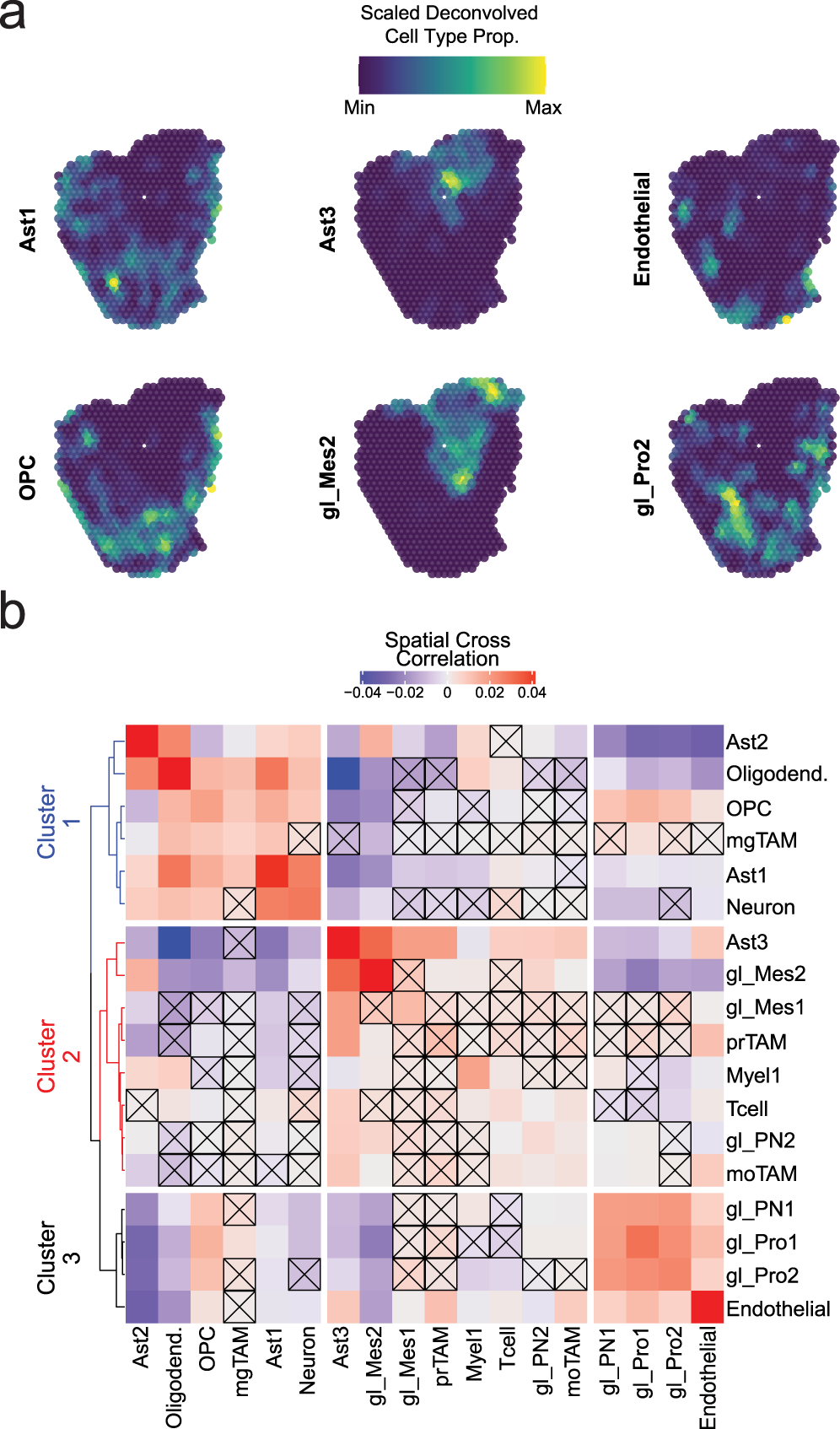
A spatial transcriptomic view of human IDH-wildtype GBM-infiltrated tissue. Different malignant and non-malignant populations share a landscape; each map is scaled within that cell population. Reproduced unmodified.
What this means for our research
State is a variable to measure, not a label to assume. We would test whether a proposed dependency remains relevant after the treatment the programme is intended to follow.
NEUVIOR's reviewed programme record describes research design and evidence synthesis. Explore the programme.
Questions to take away
• Was the state measured when the experiment actually happened?
• How many independent tumours or donors were included?
• Does the evidence show a marker, a dependency or a lasting functional effect?
Educational editorial draft | Scientific and clinical review pending.















