Invest in the next useful finding.
An early research programme creates value when it changes what somebody can reasonably decide next. The finding may support a stronger proposition, reveal a narrower application or show that a direction should stop. A larger experiment or a more complex model does not automatically make that decision clearer.
NEUVIOR’s research investment conversations begin with this relationship between the question, the study and the next step. Our programme spans Medicines Intelligence, Resource Economics and biomedical investigation. Each has a different path towards use, a different evidence requirement and a different potential development partner.
Medicines Intelligence: test the complete workflow.
PHARMORIS is being developed to connect medicines evidence with accountable action and review. A valuable assessment should examine the work around the software as well as the software itself: preparation, professional checking, coordination, implementation and subsequent evaluation. The comparison needs competent existing practice in a defined setting.
For a development or investment discussion, the useful questions concern buyer need, the proposed task and evidence of repeat value. A study should distinguish a technically interesting function from a workflow an organisation would choose to adopt. NICE’s digital-health evidence standards framework provides a reference for planning relevant evidence; it does not endorse PHARMORIS or establish its readiness.
Resource Economics: connect performance with an adopter.
PHARMORIS-ECO investigates predictive energy approaches for fixed pharmaceutical chilling and freezing. ZYLON’s initial feasibility work explored bio-derived materials and selected recovery opportunities. Further development needs a functional comparison and an intended industrial use, rather than an isolated environmental headline.
A manufacturer may need to understand process stability, implementation cost or the specification a material must satisfy. A worthwhile next study focuses on the uncertainty that currently prevents that decision. The result should explain its conditions, the limitations of the comparison and what an industrial partner would have to establish before adopting a change.
Biomedical research: ask what would alter the development case.
The glioblastoma recurrence direction asks which treatment-surviving populations matter to regrowth and what dependencies could justify further investigation. A proposed study needs relevant models, credible controls and a way to distinguish mechanism from an incidental association. Published research informs the questions; it is not a NEUVIOR result.
A development proposition would also need reproducibility, an intervention strategy, an exposure rationale and rights to the materials and data on which the work depends. Those requirements belong in the planning from the beginning. Funding a biological question is different from financing a clinical programme, and neither implies that a therapeutic candidate has been established.
An experiment’s cost includes its difficult handovers
A published replication project recorded the time spent in preparation, experiments and review. Its historical experience gives investors a concrete reason to ask which commitment a proposed milestone actually supports.
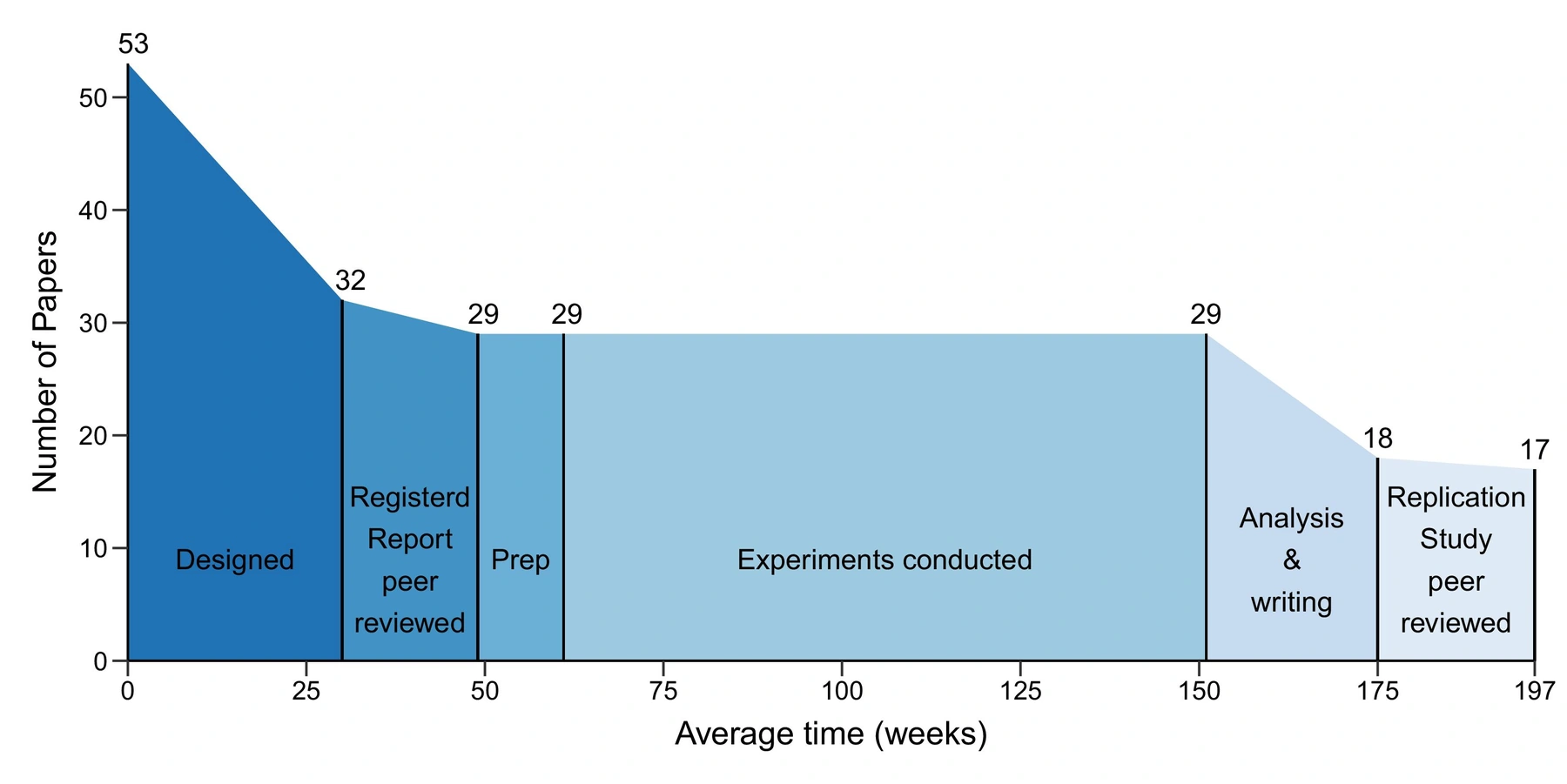
External meta-research: Errington et al. (2021), Figure 4, reports stages and durations from the Reproducibility Project: Cancer Biology. These are historical observations from that project, not NEUVIOR budgets, development timelines or investment-return forecasts.
Timothy M Errington, Alexandria Denis ... Brian A Nosek · An experiment’s cost includes its difficult handoversCC BY 4.0 | Inspect the complete figure
Source and image notes
Faithful proportional viewing copy in WebP; complete original figure and all panels retained. No crop, colour adjustment, relabelling, animation or added data.
Research investment | Spend against a decision
What uncertainty would this research investment actually remove?
An early research investment should make a specific next choice more assessable. Compare the uncertainty being investigated with the commitment that would follow different findings. This exercise helps a scientific partner, sponsor or investor challenge whether the proposed milestone earns its cost, rather than assuming that a larger study or a favourable headline necessarily creates value.
Editorial decision model, not measured NEUVIOR results. Spatial positions indicate relationships, not measured quantities.
The design must resolve the uncertainty being funded.
A scientific reviewer can ask whether the proposed comparator, model and measurement actually address the decisive assumption. Uncertainty that the study cannot resolve should remain visible in the investment case. The output should be an interpretable finding, including an explanation of what an inconclusive result would mean.
Challenge the link between the research design and its promised decision.
The next cheque should have more than one possible answer.
An investor or sponsor can ask how each possible finding changes the next commitment and which rights or dependencies remain outside the study. This keeps a research milestone separate from a forecast return, an available grant or an assumed commercial asset that the evidence has not established.
Request the staged commitment, downside response and appropriate information-access route.
Decisive uncertainty
The first question is which unknown currently prevents a sensible commitment. For software it may be task value; for a biological programme it may be the causal explanation; for a resource application it may be functional performance under operating conditions.
- Select the informative test
A programme-specific decision and the assumption most likely to change it.
A useful next stepWhich unknown would still prevent a decision after the proposed work?
A milestone is more investable when its finding can change the commitment that follows.
A research apparatus must answer an investable question
A research platform becomes commercially interesting when its next uncertainty is explicit. This published cell time-lapse from deformable-surface bioreactor research gives a development team an observable readout to question, alongside the intended user, operating conditions, comparator and cost of producing a reproducible answer.
Published time-lapse from research on endothelialisation of deformable surfaces, Supplementary Video 3. The source clock shows acquisition time; the viewing movie compresses that observation. This is an external cell experiment, not a NEUVIOR platform or commercial product.
Bachmann B, Bernardi L, Loosli C, Marschewski J, Perrini M, Ehrbar M, Ermanni P, Poulikakos D, Ferrari A, Mazza E · A research apparatus must answer an investable questionCC BY 4.0 | Original research and methods
Source and image notes
H.264 viewing copy; complete frame retained with proportional downscaling where required; no colour enhancement, crop, speed change or added frames. Audio omitted; original source remains linked.
Name the intended use
Start with the observed surface and source clock. Use the original methods to identify the cells, flow and surface conditions before interpreting the change.
Connect evidence to a decision
A funding case needs a defined comparison, reproducibility, user value and development cost beyond an impressive apparatus.
Give the milestone a decision and a consequence.
A useful milestone states what will be tested, what evidence will be produced and how different findings would affect the next commitment. It should identify the comparison, the study’s limits and the expertise needed to interpret the result. An inconclusive finding deserves a planned response as much as a promising one.
This makes the proposition easier to assess. An investor can examine what uncertainty the funding is intended to remove. A scientific partner can challenge whether the design can answer the question. A commercial partner can judge whether the output relates to a real adoption decision. The next commitment should follow the evidence produced.
Fund the uncertainty that matters.
A research milestone should leave the next decision clearer. The study needs to identify what evidence would change the case and what it would mean if the anticipated finding does not appear.
That discipline applies across software evaluation, material performance and biological research. An attractive result earns further commitment through a relevant comparison, not by becoming an impressive image.
Match the route to the stage of the work.
Sponsored research, a collaborative study, a scoped commercial assessment and company investment are different arrangements. They carry different contributions, rights, decision processes and expectations. A first discussion should identify the appropriate route rather than treating every interested organisation as a customer or every useful meeting as an investment commitment.
MRC’s translational-funding guidance illustrates the importance of matching a development question with the appropriate stage and scheme. It is contextual guidance, not a statement of NEUVIOR eligibility or an available award. For a collaboration, the Lambert toolkit provides a starting point for discussing principles and intellectual-property arrangements with suitable advice.
Make the opportunity assessable before asking for commitment.
The initial briefing should explain the programme’s present stage, the next question, the proposed contribution and what would remain uncertain afterwards. A more detailed discussion can address budget, delivery dependencies, rights and the basis for a further step. Confidential information should be shared only within an appropriate agreed process.
We welcome investors and development partners who can contribute relevant capital, expertise or a route towards use. Tell us which programme interests you and which type of participation you are considering. The first objective is to establish a credible fit and a decision worth pursuing; this page does not present an investment offer or promise a return.
Questions with a destination
Find the work
that matters to you.
Start with the decision your organisation needs to make. Each reading journey explores the practical problem, the evidence worth examining and a possible focused evaluation.
18 questions to explore
Research with a destination
Evidence review quality
Explore a proposed medicines evidence study comparing source fidelity, review quality and total checking effort, with a clear decision for research partners.
A case worth building
PHARMORIS buyer demand
Examine PHARMORIS demand through a recurring medicines task, an accountable buyer and a realistic purchasing route, with evidence needed before further investment.
Research with a destination
Implementation research
Investigate why agreed medicines changes stall, where delivery work accumulates and which implementation conditions a pharmacy or health-system partner could test.
A case worth building
Recurring workflow value
Explore when repeated medicines work could support continuing PHARMORIS value, comparing subscriptions, periodic services and the full cost of staying useful.