
Investment in capability begins with a reason to use it
Constellation’s investment case starts with the work a place could enable: access to selected scientific capability, a useful footprint for growing companies and an operating environment that supports both. The original V-campus concept expresses that ambition through two complementary wings and a public heart.
This is a proposed development programme with a staged route from scoped activity to a possible hub and later purpose-built space. It has a different capital profile from PHARMORIS and NEUVIOR’s company investment case. A campus proposition should earn support through identifiable users, delivery capability and a credible account of income, cost and risk for the phase being considered.
Users and demand
In CBRE’s H1 2026 research for the Scottish Enterprise area, 35 of 70 active laboratory and office accommodation enquiries sought 2,500 sq ft or less. That is a useful market signal for flexible smaller suites and an offer that can grow with the user.
The Constellation case must develop its own evidence from that starting point. A technical requirement, a priced proposal and an executable commitment carry different weight. We want to understand the tasks users need to perform, the support they expect, their timing and the alternatives available. Those details determine which capability and space could create a worthwhile first phase.
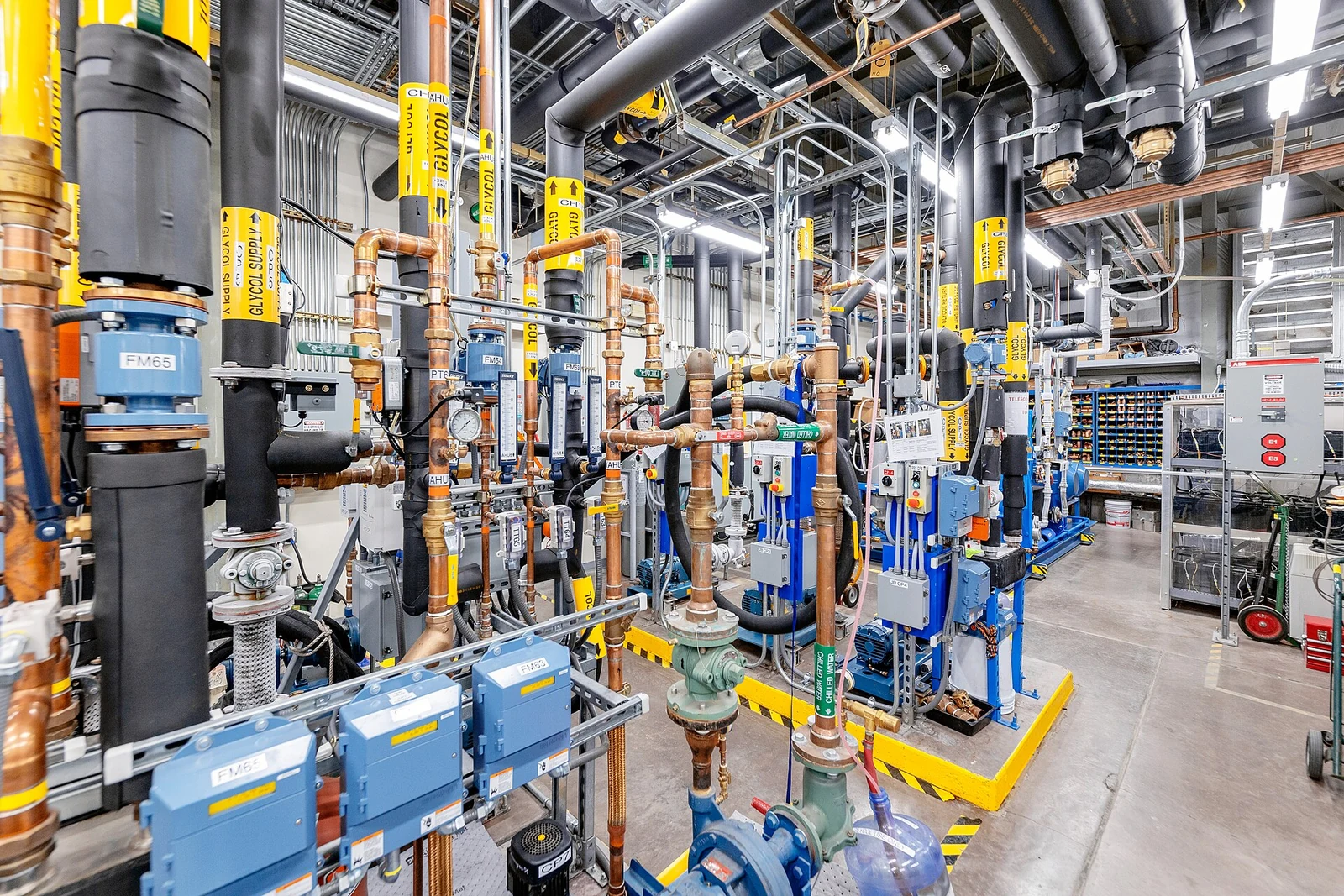
The plant-utility room at Gemini North on Maunakea shows the physical services behind scientific space. Independent infrastructure reference; no NEUVIOR ownership, cost or performance is inferred.
International Gemini Observatory/NOIRLab/NSF/AURA/ T. Slovinský · Gemini North Plant-Utility Room (6V7A4631-CC).jpgCC BY 4.0
Roles and delivery
Potential income can come from workspace occupancy, technical services, scoped collaborations and training. Each needs its own account of the customer, price basis, delivery cost and continuing demand. A shared instrument room and a private suite may serve related users while having different economics.
Workspace analysis should compare effective income per lettable area with the costs and obligations of providing that space. A technical service should examine qualified staff time, consumables, equipment use, maintenance and support. Agreements need to make clear which services are included and which are separately charged, so the same income or cost is not counted twice in the model.
Delivery also needs clear roles. A property owner, technical operator, scientific lead and public-programme team carry different responsibilities. A credible agreement should allocate services, maintenance, quality, staffing and the consequences of interruption to the people able to manage them. Those responsibilities belong in the cost model as well as the operating brief.
Infrastructure and operations
A development budget needs to distinguish building or refurbishment, technical fit-out, equipment, professional fees, contingency and the working capital required to start. These categories have different timing, useful lives and risks. The concept has not yet been converted into a site-specific cost plan.
The operating model then needs to account for staff, consumables, waste, utilities, maintenance, rent or property costs, administration and continuity. The Discovery Gallery has a separate public programme and operating budget, with educational support, sponsorship or concession income assessed on their own terms. A credible case makes those obligations visible before judging whether the combined place is affordable.
Capital and operation
Which income route carries which continuing obligation?
A campus combines activities whose economics should remain distinguishable. Compare the cost and responsibility behind workspace, scientific access, public discovery and the development phase itself. The exercise helps an investor ask whether each contribution is credible on its own and whether shared costs have been counted only once.
Editorial decision model, not measured NEUVIOR results.
Different revenues need different evidence.
The investor can distinguish a conditional occupancy assumption from repeatable service demand and test what each customer would actually receive. This avoids treating one prospective user as several independent income streams. The cost case should preserve the same distinction through staffing, maintenance and utilities.
Ask for separate accommodation and service contribution assumptions.
A first phase needs a workable life before expansion.
Slower uptake, fit-out changes and delayed funding can affect both cash and service quality. The useful downside case identifies what could shrink, remain external or pause while maintaining the obligations already taken on. It should not rely on an unfunded future development.
Identify the smallest phase whose operating commitments can be supported.
Workspace income
Lettable accommodation needs an effective income case after incentives, vacancy and the obligations included in the agreement. Occupied space cannot automatically establish utilisation of a technical service, particularly where tenants obtain specialist support from other providers.
- Accommodation obligations
- Avoid double counting
Lettable area, actual terms, included services and uptake assumptions.
A useful next stepSeparate accommodation income from separately charged technical access.
Separate ledgers make the campus proposition easier to examine and harder to inflate through shared assumptions.
Development model
The first stage can fund a scoped programme using existing capability. It should clarify demand and the practical cost of delivery. A leased hub becomes a possible next step when identified users, fit-out requirements, a capable operator and an affordable arrangement can support it.
A purpose-built V campus is a larger decision. It requires site control, professional feasibility, an operating brief, credible user commitments and financed delivery. Each stage should leave the investor with stronger evidence and a more precise next choice. A smaller phase or continued external access can be a valuable outcome when that is what the demand and economics support.
Development milestones
Development milestones should test the commercial model as well as the physical project. An attractive base case needs a comparison with slower uptake, different pricing and changes in delivery cost. Workspace occupancy and utilisation of technical capability should be examined separately. An occupied suite can coexist with an underused service, while a busy service may have staffing or maintenance constraints that limit its contribution.
The model should show how these drivers affect cash, staffing, working capital and the ability to maintain a reliable offer. It also needs a response if a proposed occupier withdraws, fit-out costs rise or the next funding stage arrives later. Reducing scope, changing the mix of services or retaining accessed capability should remain real options in the development case.
Scotland and potential funding routes
Scotland is under consideration, with local demand and delivery arrangements still being examined. Public funding research needs to match the proposed activity. Scottish Enterprise’s Life Sciences Accommodation Programme concerns qualifying accommodation development and fit-out. The UK Life Sciences Innovative Manufacturing Fund concerns qualifying manufacturing capital projects.
Those routes have different applicants, conditions and purposes. A research hub, a gallery and a manufacturing project require distinct cases. Any application would need to satisfy the current criteria and fit a viable financing plan. NEUVIOR’s existing research-project support is part of its company record; Constellation capital has to be assessed and secured for the development itself.
Briefing
We welcome developers, operators, investors and institutions who can contribute to a specific stage. The next useful discussion should establish the relevant user demand, proposed operating responsibility, capital scope and the evidence needed before a commitment.
Tell us whether your interest concerns specialist services, a first hub, property development or the wider campus proposition, and what experience or resources you could bring. We can shape a briefing around that role and the assumptions it needs to examine. The aim is a development case whose scientific purpose, commercial model and delivery responsibilities can be assessed together.
Continue the programme
- Discuss the Constellation investment thesis
Frame a Constellation investment discussion around demand, operating economics, phased capital and the evidence needed before a campus commitment.