Quality Assurance & Regulatory Science
Engineer evidence so another qualified person can reconstruct, challenge and govern it.
Status: Proposed capability · subject to evidence gates
Current boundary: Illustrative proposed experiment envelope. This is not performed work, a protocol, an installed capability, a service offer, a validated method or evidence of an operating laboratory. No GMP, GLP, manufacturing-licence, clinical or regulatory-readiness status is claimed.
Technical explanation
• A proposed quality and regulatory science environment could test how intended use, critical attributes, methods, systems, data, deviations, changes and decisions remain connected through a product or technology lifecycle.
• The programme would distinguish development evidence from validation, regulated records, batch disposition and regulatory submission. Quality risk management would inform, but not excuse, applicable legal and GMP requirements.
In everyday terms
• Quality is not a final inspection. It is the ability to show what happened, why it happened, what changed and who was responsible.
• The proposed programme would test whether one conclusion can be rebuilt from original evidence before it is trusted or transferred.
Illustrative enquiry model
Illustrative evidence-reconstruction and fault-injection exercise
Question: Can an independent reviewer reconstruct one scientific conclusion across material, method, raw data, calculation, interpretation, change and authority?
Variables
• System and document version
• Missing or late metadata
• Role and review sequence
• Injected audit-trail, calculation or sample-state fault
Observations
• Traceability completeness
• Detection and escalation time
• Impact assessment quality
• Recovery, correction and prevention evidence
Controls
• Known complete reference record
• Predeclared injected faults
• Independent reviewer
• Stage-appropriate quality and legal scope
Decision informed: Improve the evidence architecture, restrict system use, require validation or specialist quality support, or stop the transfer.
Scientific model and assumptions
Process capability as one limited signal
Model: Cpk = min[(USL - μ)/(3σ), (μ - LSL)/(3σ)]
Assumptions
• The process is sufficiently stable for the calculation
• Specification and sampling are scientifically justified
• Distribution and independence assumptions are assessed
Interpretation: Cpk compares process location and spread with limits. A high value cannot replace process understanding, data integrity, patient relevance or an authorised quality decision.
Accessible files can still leave the evidence incomplete.
Roche and colleagues assessed the completeness and reusability of archived datasets from ecology and evolution studies. Their external survey illustrates why locating a file is different from reconstructing the evidence behind a conclusion. It offers a research-data example for the proposed evidence architecture, not pharmaceutical compliance findings or a validated NEUVIOR quality system.
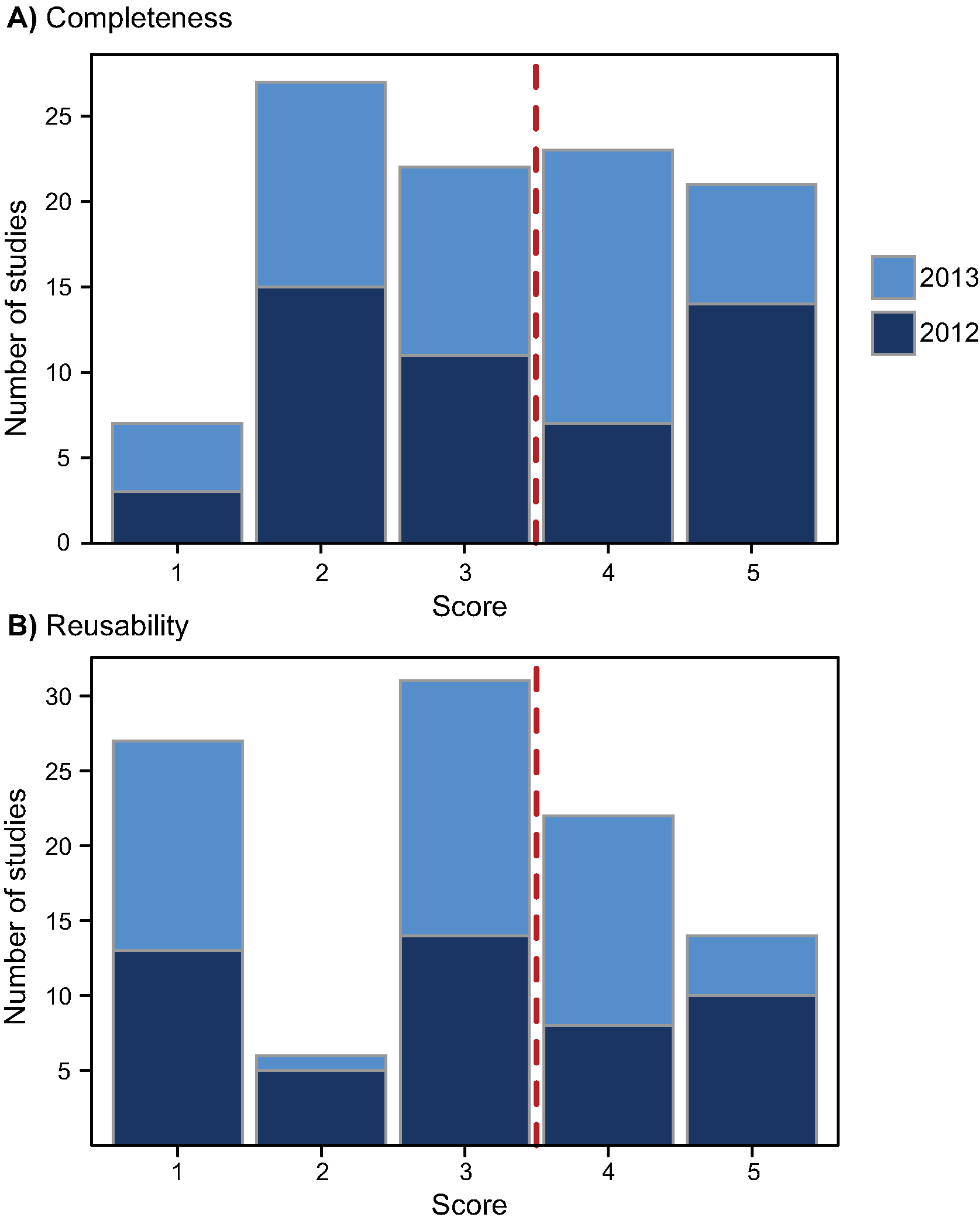
External published research-data assessment: Roche et al. (2015), Figure 2. Completeness and reusability scores for 100 ecology and evolution study datasets from 2012 and 2013. The original panel labels, scoring scale and policy-reference lines are retained; these are not pharmaceutical GxP findings or NEUVIOR audit results.
Dominique G. Roche; Loeske E. B. Kruuk; Robert Lanfear; Sandra A. Binning · Accessible files can still leave the evidence incomplete.CC BY 4.0 | Inspect the complete figure
Source and image notes
Full figure retained; no cropping, relabelling, recolouring, panel removal or data changes. Publisher original dimensions retained without upscaling; converted to lossless WebP. Original mode RGB.
Quality and regulatory science | Rebuild the conclusion
Could another reviewer reconstruct this scientific conclusion?
A summary can look convincing while the connection to its material, method or calculation remains incomplete. Select the records available for one conclusion and inspect where the trace would break. This exercise frames an independent reconstruction question; collecting the items does not validate a system, approve a batch or establish regulatory compliance.
Editorial decision model, not measured NEUVIOR results. Spatial positions indicate relationships, not measured quantities.
A conclusion needs more than its final value.
The reviewer can follow one trace from material to calculation and identify where a connection is missing. The aim is to expose a specific reconstruction problem. The presence of documents in a checklist does not determine their adequacy, authenticity or suitability for a regulated decision.
Identify the first missing connection and the narrower statement the evidence can support.
Material and sample
A conclusion depends on what was examined. Material identity, sample state and the relevant handling history need to connect with the observation. If those records cannot distinguish the intended sample from another preparation, the later analysis may be precise without answering the right question.
- Defines the examined object
- Preserves the record
An unambiguous material or sample identity with its relevant state and history.
A useful next stepCan the reviewer establish what was actually measured?
A reconstructable conclusion gives another qualified person a way to challenge the decision before relying on it.
A robot action still needs an acceptance condition
A quality discussion becomes clearer when the intended action can be inspected. This published closed-loop larva-transport movie gives viewers a bounded example for asking what successful detection, pickup, placement and recovery mean before describing an automated process as dependable.
Published real-time pickup and drop-off of three fly larvae by an automated transport system. This external research demonstration is not medical robotics or a NEUVIOR validated system.
Yu et al. · A robot action still needs an acceptance conditionCC BY 4.0 | Original research and methods
Source and image notes
H.264 viewing copy; complete frame retained with proportional downscaling where required; no colour enhancement, crop, speed change or added frames. Audio omitted; original source remains linked.
Separate detection and placement
The visible action has several stages; success at one stage does not establish the whole workflow.
Define the exception
A dependable operating procedure needs a response to missed detection, failed pickup or an unexpected destination.
Indicative equipment and dependencies
Electronic quality-management sandbox
Role: Test event, change, CAPA, training and approval workflows without implying a validated production system.
Dependencies
• Defined intended use
• Role and access model
• Controlled test data
ELN and LIMS interoperability environment
Role: Challenge sample, method, result and decision continuity.
Dependencies
• Identifier model
• Interface ownership
• Exception and reconciliation route
Chromatography data-system governance layer
Role: Evaluate raw data, processing, reprocessing, audit trail and review controls.
Dependencies
• Technique owner
• Access segregation
• Original record retention
Audit-trail analysis workbench
Role: Support risk-based review of events and injected failure cases.
Dependencies
• Context and authorised reviewers
• False-positive assessment
• Version control
Regulatory knowledge and submission room
Role: Map claims, evidence, gaps and jurisdictional assumptions.
Dependencies
• Current specialist advice
• Confidentiality and access
• No fictional submission state
Data and human authority
Data layer
• Source-to-decision traceability
• Identity, role and signature state
• Audit trail, change and deviation context
• Jurisdictional requirement and claim map
Human authority: Named scientific, quality, regulatory and data owners retain independent approval and stop rights appropriate to the stage.
Prohibited automation: No software may release a batch, certify compliance, close a critical deviation, approve a regulatory claim or override an accountable quality authority.
Potential output and stop condition
Potential output: An evidence-readiness dossier with traceability, gap, risk, ownership, validation and jurisdictional questions separated.
Stop gate: Stop when original evidence, accountable ownership, system state, legal route, quality independence or receiving-party acceptance is inadequate.
Campus design implications
Constellation is one developing campus concept. Scotland is among the locations under consideration; the programme does not currently present a second committed campus in India or elsewhere.
A capability brief before a location decision
MHRA- and ICH-informed development evidence, data integrity, future technology transfer and responsible AI governance.
ICH, CDSCO and revised Schedule M requirements mapping for development, transfer and a separately gated future manufacturing pathway.
Design for the chosen site and its users
Secure review suites separated from development laboratories, with visible source-to-decision architecture.
Secure partner diligence, data governance and quality-training rooms linked to laboratory and future manufacturing flows.
These are alternative requirements to test against climate, product scope, users and the local operating route. They describe a design brief, rather than installed equipment, available services or an approved building.
The investment question
Could help teams enter partner, investor and future regulatory conversations with clearer evidence boundaries.
Could strengthen cross-border transfer packages while keeping development and licensed manufacturing states distinct.
Potential users
Type: Product and technology developers
Need: A readiness view before transfer, validation or regulatory interaction.
Proposed deliverable: A source-to-decision gap and governance package.
Type: CROs, CDMOs and receiving laboratories
Need: Clear ownership, method, data and acceptance boundaries.
Proposed deliverable: A controlled receiving-party assessment.
Type: Scientific software and instrument suppliers
Need: A realistic data-integrity and intended-use challenge.
Proposed deliverable: A scoped assurance study without compliance certification.
Sustainability questions
Metric: Right-first-time evidence package
Method: Track preventable rework attributable to missing, inconsistent or inaccessible records.
Decision informed: Reduce repeat testing without weakening independent review.
Metric: Data retention burden
Method: Measure storage, duplication, retrieval and lawful retention by record class.
Decision informed: Design proportionate records rather than indefinite duplication.
Metric: Quality event learning
Method: Track recurrence, time to detect and verified effectiveness of actions.
Decision informed: Measure whether governance changes outcomes rather than merely closing records.
Safety and regulatory gates
• Current intended use and jurisdiction confirmed
• Scientific knowledge linked to patient or user risk
• Independent quality authority and documented decision rights
• GxP data-integrity assessment where applicable
• Validation state matched to intended use
• No licence, inspection, validated-system or regulatory-acceptance claim without documentary evidence
Sources and scientific attribution
ICH Q9(R1) quality risk management
Source type: Official framework
Relevance: Provides current principles and tools for pharmaceutical quality risk management and risk-based decisions.
Caveat: Quality risk management cannot justify non-compliance or replace applicable requirements.
Source: https://database.ich.org/sites/default/files/ICH_Q9%28R1%29_Guideline_Step4_2023_0126_0.pdf
MHRA GxP data integrity guidance
Source type: Official framework
Relevance: Provides UK expectations for data governance and integrity across GxP systems.
Caveat: The appropriate controls depend on actual intended use and regulated scope.
Source: https://www.gov.uk/government/publications/guidance-on-gxp-data-integrity
CDSCO Drugs Rules and Schedule M context
Source type: Official framework
Relevance: Provides the statutory Indian rules that must be read against a future operator, product and activity.
Caveat: Specialist current Indian advice remains necessary; no licence or GMP readiness is represented.
Source: https://cdsco.gov.in/opencms/opencms/en/Acts-and-rules/Drugs-Rules/