
Packaging, Materials & Device Interfaces
Treat the pack as part of the product, evidence and environmental system.
Status: Proposed capability · subject to evidence gates
Current boundary: Illustrative proposed experiment envelope. This is not performed work, a protocol, an installed capability, a service offer, a validated method or evidence of an operating laboratory. No GMP, GLP, manufacturing-licence, clinical or regulatory-readiness status is claimed.
Technical explanation
• A proposed packaging and materials environment could connect moisture and oxygen transport, extractables and leachables strategy, seal and closure integrity, light protection, mechanical resilience, usability and recyclability to product-specific risk.
• Material selection would be multi-objective. A lower-carbon or recyclable pack would still need to protect the product and user; a high-barrier pack would still need a credible whole-life and supply case.
In everyday terms
• Medicine packaging protects the product from air, moisture, light, damage and misuse. Changing a material can help one problem and create another.
• The proposed laboratory would compare those trade-offs before anyone claims a pack is safer, greener or suitable for shelf life.
Illustrative enquiry model
Illustrative barrier-integrity-circularity comparison
Question: Which candidate pack provides the required barrier and mechanical performance while preserving usability, material efficiency and an evidence-based end-of-life route?
Variables
• Polymer, glass, foil or coating structure
• Wall thickness and seal condition
• Temperature, humidity and light exposure
• Distribution shock and vibration
Observations
• Water-vapour and oxygen transmission
• Seal or container-closure integrity
• Mechanical and dimensional change
• Product-relevant compatibility signal and material footprint
Controls
• Qualified reference pack
• Mapped environmental conditions
• Predeclared defect challenges
• Product-specific analytical and toxicological strategy where required
Decision informed: Advance a material system for formal development, redesign the pack, commission specialist testing or stop an unsupported sustainability claim.
Scientific model and assumptions
Permeation and temperature dependence
Model: J = PΔp/l · ln k = ln A - Eₐ/RT
Assumptions
• Transport approximates steady state in the tested domain
• Permeability and thickness are measured for the actual system
• Arrhenius behaviour is assessed rather than assumed across all conditions
Interpretation: The first relationship describes flux through a barrier. The second describes one possible temperature dependence. Neither establishes shelf life without product-specific stability evidence.
Moisture protection changes the storage comparison.
Yoshida and colleagues compared packaged medicines stored with and without moisture-suppression bags under one controlled temperature and humidity condition. Their external measurements make the pack-and-product interaction visible. They are a reason to define product-specific testing, not a NEUVIOR result, shelf-life determination or recommendation to adopt a particular material.
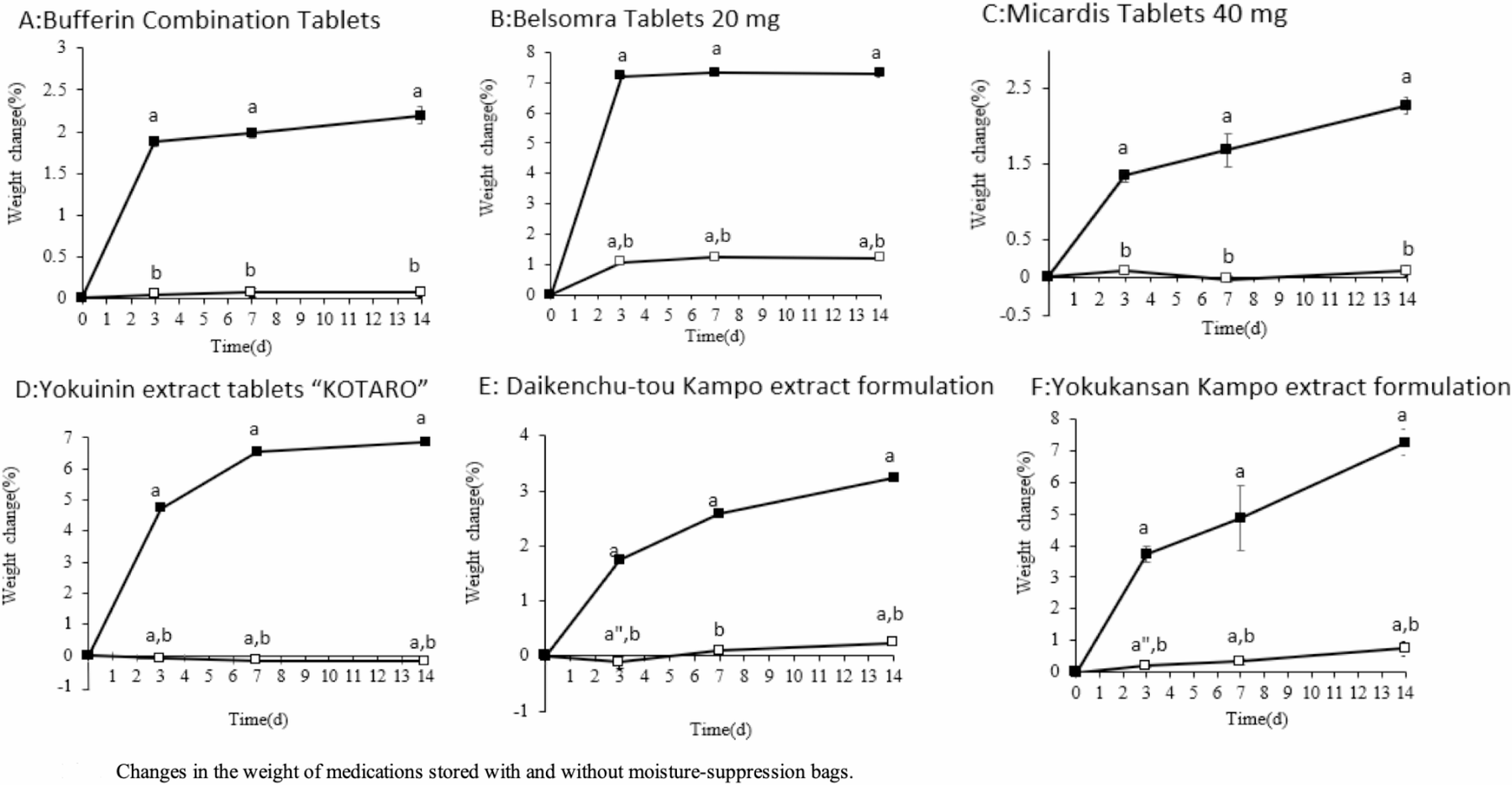
External published experimental result: Yoshida et al. (2025), Figure 3. Medication weight changes with and without moisture-suppression bags at 35 °C and 75% relative humidity, with the original six panels, error bars and significance labels retained. This is not NEUVIOR testing and does not establish another product’s shelf life.
Yoshida, Takayuki; Iijima, Hisashi; Washio, Yumeka; Toda, Makoto; Morikawa, Miho; Iwasa, Kazuhiro; Tomita, Takashi · Moisture protection changes the storage comparison.CC BY 4.0 | Inspect the complete figure
Source and image notes
Full figure retained; no cropping, relabelling, recolouring, panel removal or data changes. Proportionally resized from 2008×1042 to 1800×934 using Lanczos; converted to lossless WebP. Original mode L.
Packaging development | Protection, use and material fate
What would a greener pack still need to protect?
A packaging material can improve one attribute while creating a problem elsewhere. Inspect the requirements around a proposed pack to see why barrier performance, compatibility, usability and end-of-life evidence belong in the same comparison. The layout shows interacting obligations rather than a sustainability score, and no packaging candidate or test result is represented.
Editorial decision model, not measured NEUVIOR results. Spatial positions indicate relationships, not measured quantities.
The intended material must preserve the product question.
Barrier and compatibility evidence concern different parts of protection. A developer should identify the threat, product attribute and relevant test conditions before comparing candidates. The diagram does not supply a testing protocol or certify suitability for a particular medicine, closure or claimed storage period.
State the product-specific requirement the new pack must still satisfy.
A better material needs a usable and credible destination.
Usability and material fate can overturn an otherwise appealing candidate. The relevant people, collection system and process boundary should therefore remain visible in the same decision. The stronger proposal is the one whose trade-offs can be investigated, not the one with the most attractive environmental label.
Identify the user or end-of-life assumption that could reject the favoured material.
Product protection
Moisture, oxygen, light and mechanical handling can each matter to a particular product. A packaging comparison needs to specify which protection is required under the intended conditions. A strong result in one barrier test would not establish the complete suitability or shelf life of the pack.
- Required protection
Product-specific protection requirements and justified storage and handling conditions.
A useful next stepWhich external condition most threatens the attribute this product must retain?
A packaging decision becomes stronger when material improvement is tested against the functions the whole product must retain.
Indicative equipment and dependencies
WVTR and OTR analysers
Role: Measure water-vapour and oxygen transmission through candidate barriers.
Dependencies
• Calibrated reference films
• Conditioned samples
• Defined test method
Container-closure integrity system
Role: Challenge leakage or seal integrity using a fit-for-purpose method.
Dependencies
• Defect standards
• Product and pack geometry
• Method sensitivity assessment
DVS and thermal-analysis suite
Role: Study moisture sorption and thermal transitions in product-contact materials.
Dependencies
• Representative materials
• Controlled conditioning
• Competent interpretation
Universal mechanical, drop and vibration testing
Role: Evaluate transport and use-related mechanical performance.
Dependencies
• Defined distribution profile
• Instrumented samples
• Human-use context
Micro-CT and spectroscopy
Role: Investigate non-destructive geometry, defects and material changes.
Dependencies
• Reference artefacts
• Resolution limits
• Orthogonal confirmation
Data and human authority
Data layer
• Material and supplier provenance
• Pack geometry and conditioning
• Environmental and integrity data
• Compatibility, usability and life-cycle evidence map
Human authority: Packaging, formulation, toxicology, quality and sustainability owners jointly decide whether a candidate meets the product-specific evidence gate.
Prohibited automation: No optimisation system may declare shelf life, patient safety, regulatory acceptability or environmental superiority from barrier or model data alone.
Potential output and stop condition
Potential output: A packaging-option dossier showing barrier, integrity, mechanical, compatibility, usability, supply and sustainability trade-offs.
Stop gate: Stop or redesign when protection, compatibility, usability, supply resilience, method performance or life-cycle evidence cannot support the intended product.
Campus design implications
Constellation is one developing campus concept. Scotland is among the locations under consideration; the programme does not currently present a second committed campus in India or elsewhere.
A capability brief before a location decision
Advanced pack and device-interface science for temperature, humidity, transport and sustainable-material decisions.
Stability, barrier, primary and secondary packaging development under high heat, humidity and long distribution routes.
Design for the chosen site and its users
Controlled-condition labs linked to analytical science, design review and cold/wet distribution scenarios.
Large mapped chamber bank, heat- and monsoon-relevant conditioning and future packaging-line interface.
These are alternative requirements to test against climate, product scope, users and the local operating route. They describe a design brief, rather than installed equipment, available services or an approved building.
The investment question
Could help product teams connect formulation stability to pack and supply decisions earlier.
Could support stronger cross-border packaging knowledge and future manufacturing transfer packages.
Potential users
Type: Pharmaceutical, consumer-health and beauty teams
Need: A product-specific packaging and stability question.
Proposed deliverable: A candidate comparison and specialist-testing plan without a shelf-life claim.
Type: Packaging-material and device suppliers
Need: Independent challenge of one material or interface claim.
Proposed deliverable: A fit-for-purpose evidence package without endorsement.
Type: Manufacturers and distribution partners
Need: Pack, line and transport compatibility before transfer.
Proposed deliverable: A transfer-risk and qualification brief.
Sustainability questions
Metric: Pack mass and material complexity
Method: Record primary, secondary, tertiary and rejected material by pack delivered.
Decision informed: Reduce material without weakening protection or use.
Metric: Product loss avoided
Method: Measure only against real stability, damage or distribution failure evidence.
Decision informed: Balance packaging reduction against the larger burden of product loss.
Metric: End-of-life evidence
Method: Document actual collection, separation and recycling routes in the intended market.
Decision informed: Prevent theoretical recyclability from becoming a market claim.
Safety and regulatory gates
• Product and route-specific container-closure requirements
• Extractables, leachables and toxicological strategy where applicable
• Stability protocol and analytical method state
• Human factors, tamper evidence and child-resistance assessment where required
• Supplier and component change control
• No shelf-life, safety or recyclability claim without applicable evidence
Sources and scientific attribution
FDA container-closure systems guidance
Source type: Official framework
Relevance: Provides current FDA chemistry, manufacturing and controls context for packaging human drugs and biologics.
Caveat: The guidance does not select a material or establish suitability for an undefined product.
ICH quality guidelines
Source type: Official framework
Relevance: Provides the international guideline architecture for development, risk, quality systems, analytics, stability and manufacturing.
Caveat: Citing a guideline does not establish compliance, validation, inspection readiness or regulatory acceptance.
Source: https://admin.ich.org/page/quality-guidelines
ACS green-chemistry metrics
Source type: Official programme
Relevance: Provides material-efficiency and broader green-chemistry metric context.
Caveat: One metric cannot establish whole-life environmental superiority.
Source: https://www.acs.org/green-chemistry-sustainability/research-innovation/engineerings-metrics.html















