
Illustrative research questions, without a fictional pipeline.
The research atlas shows how future scientific questions could move through measurement, challenge and decision. Every scenario is educational. No experiment, result, product, service or active programme is represented.
Use worked scenarios to expose evidence logic and failure modes.
Technical rationale
• Each scenario begins with a defined question, identifies possible measurements and controls, and ends with an advance, redesign, specialist referral or stop decision. It does not publish invented efficacy data or imply product ownership.
• A real study would require product rights, a controlled protocol, lawful materials, suitable models, qualified operators, data governance, finance and any applicable ethics or regulatory approvals.
See what scientists might ask before an idea moves forward.
A matched comparison reveals what the demonstration leaves open
The external example compares microfluidic mixing under punch-card actuation with conventional syringe pumping at the same flow rate. Keeping photographs and quantified observations together shows why an educational scenario needs a comparator and an interpretable measurement.
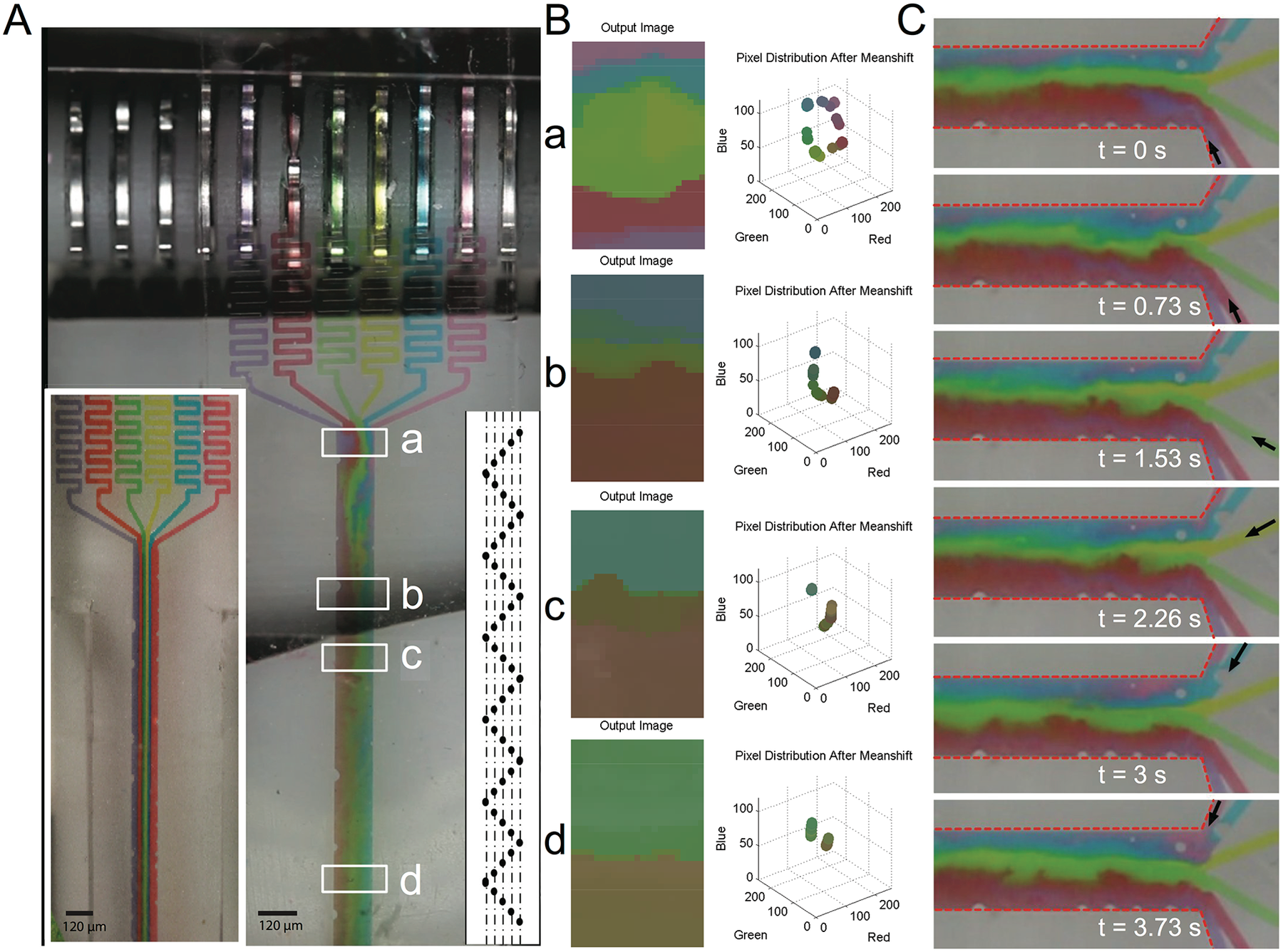
External experimental example: Korir and Prakash’s device-specific microfluidic mixing comparison (2015, Figure 3). The complete micrographs, clustering analysis and mixing sequence are retained. This is a published external result, not a performed NEUVIOR study or a medicine-product pipeline.
George Korir; Manu Prakash · A matched comparison reveals what the demonstration leaves openCC BY 4.0 | Inspect the complete figure
Source and image notes
Complete figure retained; proportionate resize from 2050×1522 to 1800×1336 pixels using Lanczos resampling; lossless WebP encoding. No cropping, relabelling, recolouring or panel removal.
Illustrative examples | Different failures need different experiments
Which observation would make this example change direction?
An educational scenario is useful when it exposes the question an experiment would have to answer. Compare four very different examples and the evidence that could make each advance, change or stop. None is a NEUVIOR product pipeline or performed study; the interaction is about choosing a revealing comparison instead of inventing a successful result.
Editorial decision model, not measured NEUVIOR results. Spatial positions indicate relationships, not measured quantities.
A product question determines the useful measurement.
The formulation examples involve different behaviours and should not inherit one generic laboratory test. A credible comparison connects the intended product with the physical attribute being measured. No numerical chart is supplied here because no underlying study was performed for these educational scenarios.
Name the product attribute and a comparison that could reject the favoured option.
A normal demonstration leaves the exception unexplained.
The automation and reconstruction examples concern the reliability of a workflow and its record. Their useful evidence includes what happens when something is missing or goes wrong. That requirement is different from a formulation measurement, even though both examples support a decision about further work.
Identify the fault or missing record a proposed evaluation must deliberately examine.
Oral compound behaviour
A poorly soluble oral-compound scenario would need to connect material behaviour with a defined formulation question. A visually clear mixture is not a sufficient performance endpoint. Solubility, precipitation and the chosen comparison would need to be interpreted under conditions relevant to the proposed product.
- Formulation comparison
Material identity, justified medium and a pre-defined formulation comparison.
A useful next stepWhat observation would make the proposed formulation approach unsuitable?
A useful example makes the possible failure informative rather than supplying a fictional success.
An ordered material still has a formation history
A worked scientific example becomes useful when the viewer can challenge its conditions. This published DNA-coated-colloid experiment makes ordering visible and invites a comparison between a striking microscopic outcome and the separate evidence required for a repeatable, fit-for-purpose material.
Published formation of DNA-coated colloidal crystals at 28.3°C. These are engineered model particles, not a medicine ingredient or a NEUVIOR material.
Wang Y, Wang Y, Zheng X, Ducrot É, Yodh J, Weck M, Pine D · An ordered material still has a formation historyCC BY 4.0 | Original research and methods
Source and image notes
H.264 viewing copy; complete frame retained with proportional downscaling where required; no colour enhancement, crop, speed change or added frames. Audio omitted; original source remains linked.
Watch local ordering
Small arrangements emerge and join; an attractive final pattern does not explain the entire formation pathway.
Ask about transfer
The particle chemistry, temperature and preparation define this experiment. Another material would require its own comparison.
In everyday terms
• Scientific work is not a machine that turns every idea into a success. Good experiments are designed to reveal weaknesses as well as strengths.
• These examples show the questions that could be asked in a future campus. They do not show work that has already happened.
Eight educational scenarios across the proposed campus.
No numerical result is shown because there is no study record behind these examples. The value is in the decision structure, not an invented chart.
Activities
Poorly soluble oral compound
A future team could compare solubility, particle form, precipitation, dissolution and excipient compatibility. The possible decision would be which formulation concepts merit controlled stability learning.
Topical formulation concept
A proposed study could examine pH, viscosity, spread, in vitro release, packaging compatibility and microbial risk planning without making a skin benefit or clinical claim.
Oral suspension concept
Particle size, sedimentation, redispersibility, viscosity, dose uniformity and storage behaviour could be compared before a candidate decision.
Temperature sensitive formulation
Thermal stress, agitation, physical appearance, particles, assay response and packaging could be considered for a defined product type and method set.
Analytical procedure transfer
Sample preparation, system suitability, analyst variation and receiving laboratory performance could be compared to reveal transfer gaps.
Process transfer scenario
Mixing, hold time, sampling, monitoring, scale assumptions and receiving equipment could be mapped before any capacity decision.
Robotic sample handling
Identity, dispensing repeatability, physical safety, failure recovery, human intervention and audit records could be challenged in an isolated proposed workflow.
Evidence reconstruction
A reviewer could test whether one proposed scientific conclusion can be traced through sample, method, raw data, calculation, interpretation and authority.
Make the campus useful before asking visitors to imagine it.
Worked scenarios can help scientists test the technical model, help investors see how evidence changes decisions and help the public understand why laboratories need more than attractive equipment.
Dependencies
• A visible statement that every scenario is educational and proposed.
• No invented results, owned assets, partners or patient benefit claims.
• Specialist review before a scenario becomes a real protocol.
• Rights, safety, lawful materials, controls, finance and accountable authority.
Gates
• Question
• Rights
• Protocol
• Safe route
• Funded decision
A scenario would become active only after its status changed through documentary evidence and accountable approval. Publication on this page would not change that status.
Current boundary: The atlas is an educational design tool. It is not a public pipeline, study register, service catalogue, equipment list, result archive or representation of activity at an existing NEUVIOR facility.















