
Campus sustainability
Every sustainability measure remains a design hypothesis until a site, baseline, engineering model, operating scope and verification method are controlled. The concept does not claim net zero, zero waste or zero liquid discharge.
Containment-led smart ventilation
Risk assessment sets safe air-change, pressure and exhaust requirements. Demand control, variable air volume and heat recovery are then evaluated without weakening containment.
Measure: Air-change rate, pressure stability, fan energy, recovered heat and out-of-range events by zone
Meter the scientific load
Building, process and plug loads are separated so energy can be understood against instrument use, experiment type, occupancy and critical uptime.
Measure: Electricity and thermal energy by building, system, laboratory zone and work package
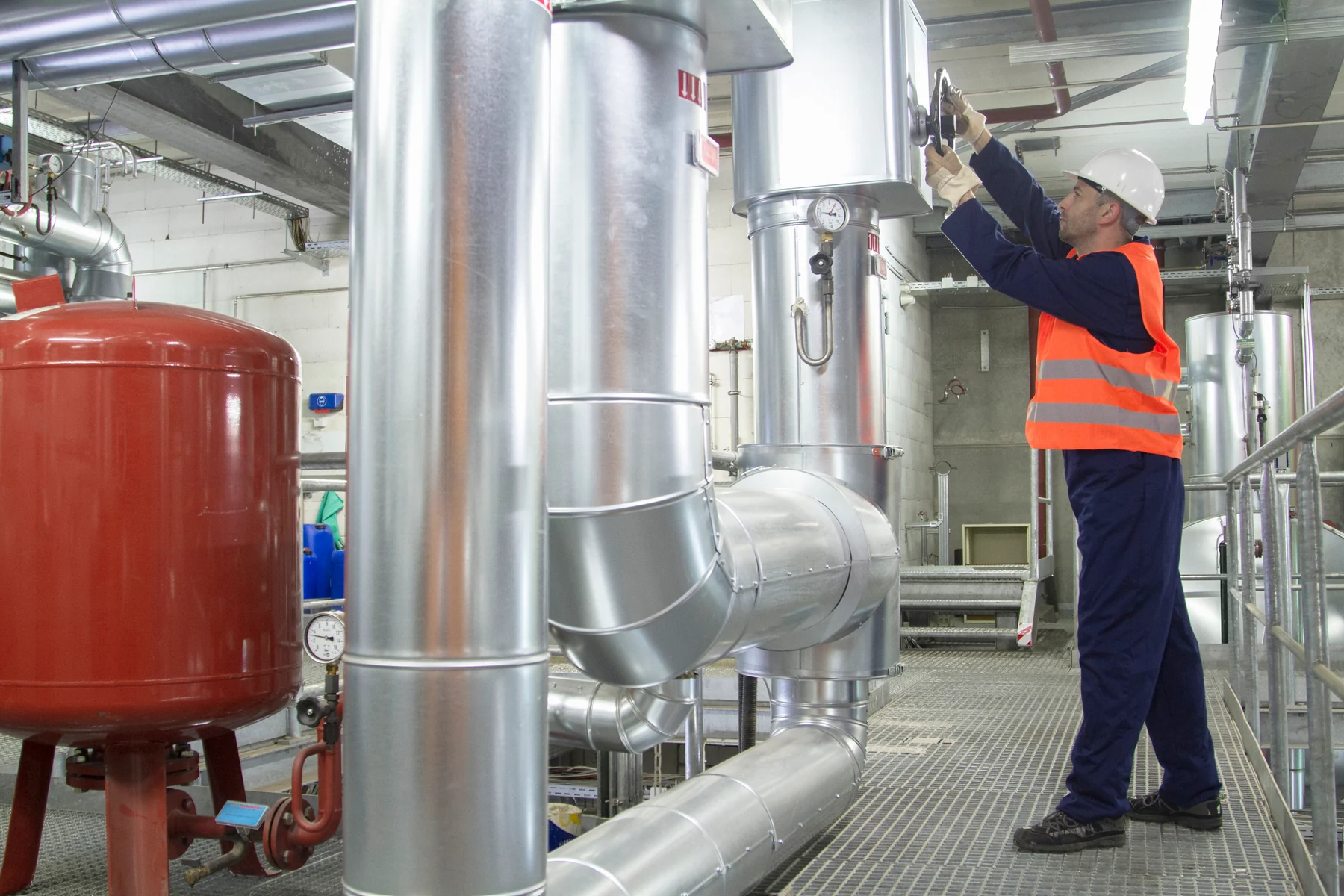
Building services have an operating life beyond the architectural concept. A campus sustainability brief needs defined duties, metering boundaries and maintenance responsibility. Illustrative power-station plant photography, credited to Sigrid Gombert / Image-Source.
Image-Source / Sigrid Gombert · Engineer Works With Pipes and Industrial MachineryEnvato Elements commercial licence
Source and image notes
Full frame retained; EXIF orientation honoured, proportionally resized and encoded as WebP. No crop, creative colour grading, compositing or generative changes. ICC-managed conversion from Adobe RGB (1998) to sRGB for consistent display.
Use the right water grade
Potable, process, purified, cooling and landscape water are not treated as one stream. Recovery and reuse depend on quality, risk and discharge evidence.
Measure: Input, grade, use, recovery, loss and discharge quality by process boundary
Laboratory engineering
Where can resource demand fall without weakening the science?
Laboratory efficiency begins with the service that must be protected. Compare the resource and control sides of the proposed campus brief: safe air, useful energy, appropriate water and traceable residuals. Different climates change the engineering priorities; they do not remove the need for site-specific evidence and accountable operation.
Editorial decision model, not measured NEUVIOR results.
Heat recovery needs a safe route and a useful sink.
A cooler site may invite exhaust heat recovery and lower-temperature distribution, but compatibility and demand must be demonstrated. Wet-weather resilience and protected recovery also matter. The appropriate study compares the recoverable service with the cost and risks of integrating it into a particular site.
Identify the clean heat sink and the contamination boundary.
Cooling and water decisions need one coherent boundary.
A hotter location may place greater value on shade, envelope design, efficient cooling and selective reuse. These choices interact through equipment, maintenance and residual treatment. The next study should preserve required water quality and critical cooling while testing local resource availability and practical operation.
Compare the cooling and water duty before sizing supply plant.
Containment requirement
Risk assessment establishes the air and containment duties the work requires. Ventilation changes should be examined against pressure stability, exposure control and safe recovery, so reduced fan demand does not become an unexplained reduction in the protection of people or science.
- Protect duty while reducing load
Activity-specific exposure and containment assessment.
A useful next stepAsk which ventilation requirement is genuinely variable.
Resource efficiency becomes credible when the protected duty and the residual burden remain visible together.
Design out solvent and material loss
Miniaturisation, closed transfer, solvent substitution and segregated recovery are tested before end-of-pipe treatment. Residual hazardous material remains visible.
Measure: Process mass intensity, solvent recovery, failed-run material and authorised disposal route
Treat waste as a controlled flow
Chemical, biological, packaging, electronic and ordinary waste need separate classification, storage, custody and documented destinations.
Measure: Mass by class, prevention, reuse, recovery, treatment and final disposal
Generate clean power where feasible
Roof and canopy photovoltaics, storage and load shifting are tested against orientation, structure, climate, critical loads, fire strategy and whole-life value.
Measure: On-site generation, self-consumption, curtailed energy, storage cycles and verified grid carbon factors
Engineer resilience without green theatre
Critical science needs defined recovery times, redundant fibre and tested local compute. Satellite connectivity may be evaluated as backup only, never the sole safety-critical or regulated path.
Measure: Critical-load coverage, recovery time, failover tests, data integrity and contingency exercises
One concept. Climate-specific engineering.
Constellation remains one location-neutral concept, with Scotland under consideration. These climate comparisons help test design requirements; they are not announcements of separate campuses.
Recover heat. Design for wet weather. Protect critical science.
Cooler, wetter conditions
For a cooler, wetter site, the brief would test high-performance fabric, laboratory exhaust heat recovery, low-temperature heat distribution, rainwater management, daylight without glare and resilient all-weather public routes. Solar generation remains site- and roof-specific.
Questions
• What heat can be safely recovered without cross-contamination?
• How will intense rainfall, drainage and landscape storage be modelled for the selected parcel?
• Which loads require uninterrupted power, local compute and tested recovery?
Reduce heat gain. Treat water as a system. Use the solar resource carefully.
Hotter conditions and water constraints
For a hotter site, the brief would test shade, efficient façades, cool roofs, high-efficiency cooling, water-grade segregation, monitored reuse and shaded gardens. Photovoltaics and storage could be material, but only after yield, grid, maintenance and fire-safety studies.
Questions
• How far can passive shade and envelope design reduce cooling before plant is sized?
• Which water streams are safe and economic to recover, and where does the residual concentrate go?
• How will gardens remain comfortable and biodiverse without ornamental water or excessive irrigation?
Sources
US Department of Energy Smart Labs
Scope: Supports laboratory energy-intensity and smart-lab operating context; US evidence, not a NEUVIOR baseline.
Source: https://betterbuildingssolutioncenter.energy.gov/accelerators/smart-labs
Scottish Environment Protection Agency special waste
Scope: Supports Scotland's controlled hazardous-waste route; exact future permits remain activity and site specific.
Source: https://www.sepa.gov.uk/regulations/waste/special-waste/
Telangana Next-Gen Life Sciences Policy 2026-30
Scope: Supports state policy direction, including greener industrial practices; not proof of delivered infrastructure.















