Laboratory benchmarks
These are independent research and infrastructure benchmarks. A citation does not indicate a NEUVIOR relationship, reserved access, funding, endorsement or equivalent capability.
Sources and scientific attribution
NIST Autonomous Formulation Lab
Scope: Official NIST project description; not a medicines-manufacturing approval.
Source: https://www.nist.gov/programs-projects/autonomous-formulation-lab
Air moves when the room boundary moves
A laboratory benchmark needs to include what happens at doors and handovers. This published airflow simulation gives prospective occupiers a concrete reason to ask about containment conditions, door operation and verification, instead of relying on a room label or a single design specification.
Published large-eddy simulation of air exchange between a hospital isolation room and an anteroom during single-hinged-door operation. This is an external simulation, not a NEUVIOR campus ventilation model.
Saarinen P, Kalliomäki P, Tang J, Koskela H · Air moves when the room boundary movesCC BY 4.0 | Original research and methods
Source and image notes
H.264 viewing copy; complete frame retained with proportional downscaling where required; no colour enhancement, crop, speed change or added frames. Audio omitted; original source remains linked. Original declared 749samples but decoded748frames; two terminal presentations at29.92s and29.88s excluded because first is outside declared end and second repeats an earlier timestamp. Kept746frames, original timestamps0..29.88s including original0.12s acquisition gap. No frames invented or duplicated.
Follow the changing boundary
A door movement changes the flow problem; a static room specification does not describe every operating state.
Ask how it is verified
Simulation settings, pressure conditions, measurements and the relevant use case must accompany a containment argument.
NSF Programmable Cloud Laboratories Test Bed
Scope: Funding programme and infrastructure direction; not a completed national network.
USTC end-to-end robotic chemistry demonstration
Geography: China
Verified: A University of Science and Technology of China research system combined literature mining, a computational planning layer, mobile robotics and fourteen workstations for synthesis, characterisation and performance testing.
Design question: Which bounded chemical workflows could be safely closed-loop, and where must a scientist approve the next experiment, exception or escalation?
Sources and scientific attribution
National Science Review: all-round AI chemist
Scope: Original research demonstration; not evidence that all Chinese laboratories are autonomous.
Source: https://academic.oup.com/nsr/article/9/10/nwac190/6694008
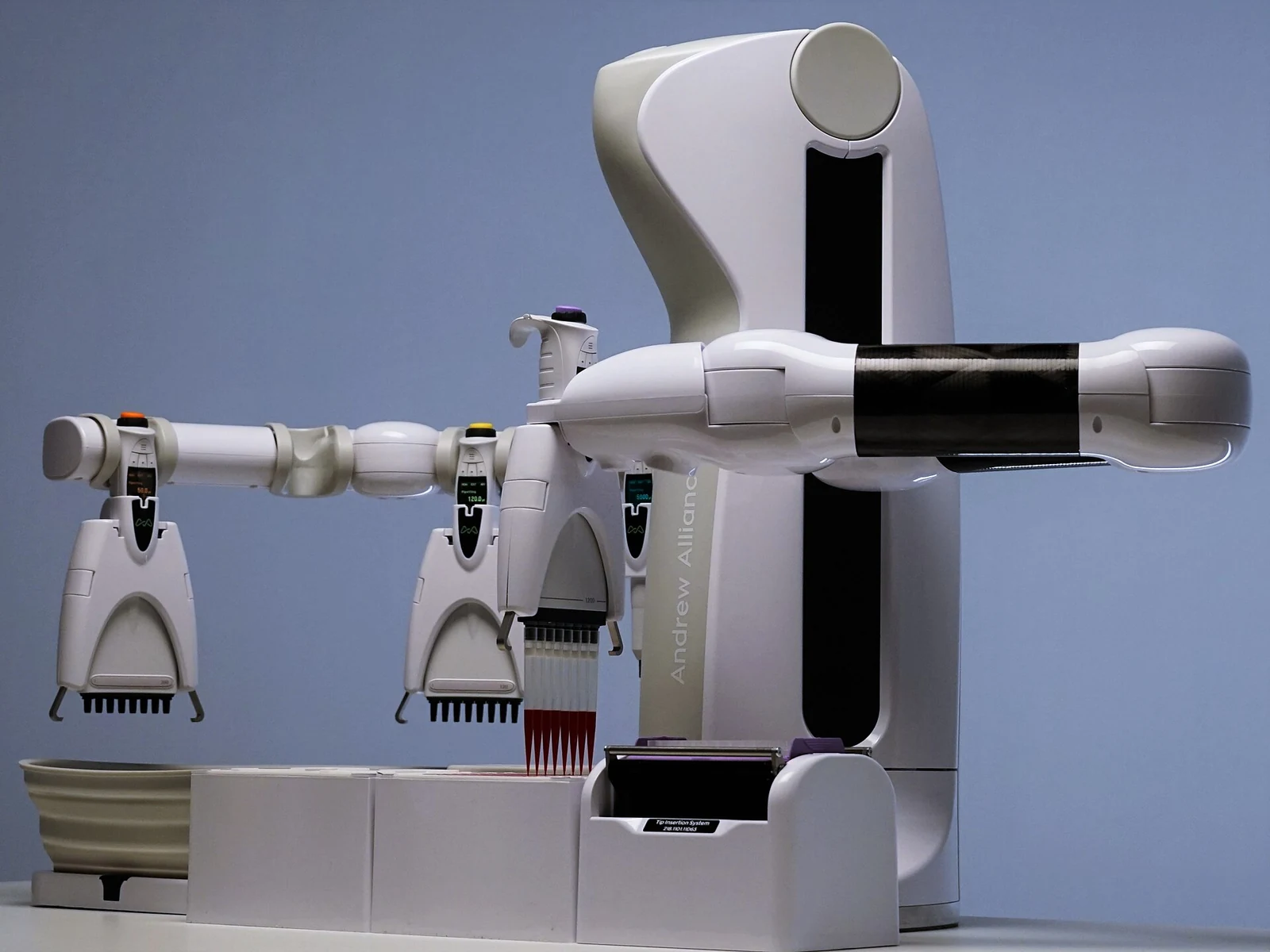
Andrew+ liquid-handling robot by Andrew Alliance, photographed by Pocar19 in 2019. External equipment benchmark for discussing laboratory automation; no installation, ownership, access, endorsement or performance result at NEUVIOR is represented.
Chinese Academy of Sciences: robotic chemist Luke
Scope: Institutional report on a defined research platform.
Source: https://english.cas.cn/newsroom/news--archives/2024/cas-in-media/202411/t20241108_1130330.shtml
RIKEN biological protocol optimisation
Geography: Japan
Verified: RIKEN reported a human-robot-AI system that evaluated 143 cell-culture conditions over 111 days from a much larger search space, improving a defined retinal-cell culture metric. The result concerned experimental optimisation, not a clinical treatment.
Design question: How should long-duration cell workflows combine robotic precision, image-based quality control, incubator continuity and accountable human decisions?
Learning from research
Which part of a laboratory breakthrough can travel?
A published automation result can inspire a programme without proving that its operating model transfers. Inspect what sits between the demonstrated method and a dependable service: instrument interfaces, review, recovery and the intended use. The comparison helps researchers and operators decide what deserves a bounded feasibility study.
Editorial decision model, not measured NEUVIOR results.
The transferable insight may be a method rather than a machine.
A scientist should establish what made the published experiment informative and which assumptions need to be retested for a new material or question. That approach produces a researchable transfer task while preserving attribution and avoiding borrowed claims about speed, throughput or discovery.
Compare the original experimental boundary with the proposed one.
Demonstrated method
A benchmark is useful when its experimental task and limits remain attached. NIST’s formulation work illustrates connected preparation and measurement; another institution’s successful result is a starting point for questions rather than evidence that Constellation can reproduce it.
- Preserve the method
Original method, material range and stated research purpose.
A useful next stepIdentify the mechanism worth investigating rather than copying the performance claim.
A strong benchmark becomes a testable operating question, with its original result still attributable to its authors.
Sources and scientific attribution
eLife: robot and AI optimisation of stem-cell differentiation
Scope: Original research supporting the reported 143 conditions and 111-day workflow; not a clinical outcome.
RIKEN: human-robot-AI teamwork
Scope: Research-process optimisation; no clinical outcome or NEUVIOR performance claim.
Source: https://www.riken.jp/en/news_pubs/research_news/pr/2022/20220628_2/index.html
RIKEN Center for Biosystems Dynamics Research
Scope: Current institutional context for AI biology and laboratory robotics.
Liverpool mobile robotics and UK medicines translation
Geography: United Kingdom
Verified: The University of Liverpool demonstrated a mobile robotic chemist working with ordinary human-scale laboratory equipment. In 2026, Innovate UK offered up to £7.5 million for digital, automated and robotic medicines process-development and manufacturing technologies.
Design question: Can adaptable robotic workcells and shared translation space complement existing British facilities without duplicating specialist capability already available elsewhere?
Sources and scientific attribution
University of Liverpool mobile robot scientist
Scope: University research demonstration using a defined workflow.
Source: https://news.liverpool.ac.uk/2020/07/08/experiment-too-big-hire-a-mobile-robot-scientist/
UKRI: medicines manufacturing labs of the future
Scope: Closed funding competition; not a NEUVIOR award or participation claim.
Source: https://www.ukri.org/opportunity/medicines-manufacturing-labs-of-the-future/
Sources and scientific attribution
Telangana Next-Gen Life Sciences Policy 2026-30
Scope: State policy intention and attributed ecosystem figures; not a completed NEUVIOR facility.
What the benchmarks can inform
Transfer the operating pattern
Shared access, modular workcells, interoperable instruments, traceable samples, machine-readable methods and explicit human approval gates can inform the brief.
Do not transfer another institution's result
A published discovery, throughput figure, clinical result or facility status belongs to its source. It is not evidence of NEUVIOR performance, demand or readiness.
Design for exception handling
Autonomy still requires calibration, maintenance, loading, safe states, deviation management and qualified people able to stop or recover the system.
Keep location claims specific
Potential host regions already have scientific assets. Constellation should establish the additional access or translation problem it could solve, compare access to existing facilities and avoid treating another institution’s equipment or results as its own.