
Evidence for the campus pathways.
This hub separates published research, official guidance and comparable facilities from NEUVIOR’s own position. It informs one developing Constellation concept, with Scotland among the locations under consideration. International examples help test the brief; they do not announce another campus or establish access to any cited institution.
Public project records with a controlled disclosure boundary.
The record links only project-level sources already in the public domain. It separates NEUVIOR's execution record from any future capital package for NEUVIOR and does not derive or publish company-wide funding totals.
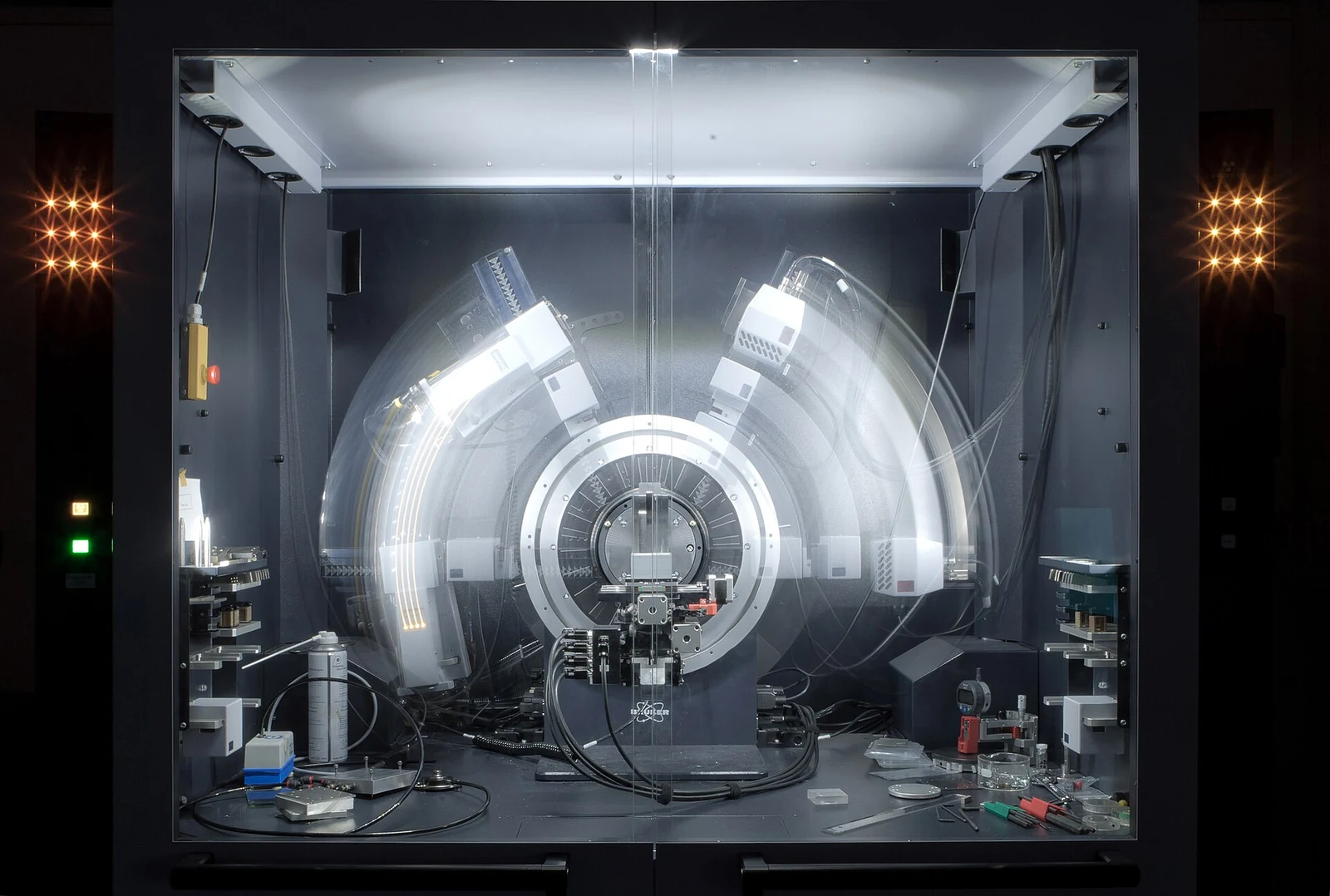
A long exposure records the motion of an X-ray diffractometer. Independent analytical-instrument reference; the light traces represent camera exposure rather than additional hardware or an installed NEUVIOR capability.
Evidence informs a question. It does not transfer a claim.
Every source below is primary, peer-reviewed or published by the responsible institution, regulator or government. Its limits travel with it.
Learn from operating ecosystems without implying access.
These official records show relevant capabilities or shared infrastructure models elsewhere. They are comparators, not NEUVIOR partners, appointed providers or evidence that equivalent facilities exist within either proposed campus.
Evidence interpretation
What can this source actually establish here?
A comparator, a scientific paper and a regulatory guideline contribute different kinds of knowledge. Inspect how each can shape a Constellation question without transferring somebody else’s facility, result or approval to NEUVIOR. The distinction helps researchers, investors and partners ask for the right evidence at the next decision.
Editorial decision model, not measured NEUVIOR results.
Use the source to improve the question.
A researcher can identify an instrument pattern, method or service arrangement worth examining. The next step is to specify how the proposed use differs and what would need to be tested. Attribution and limitations stay attached to the insight throughout that transfer.
State what is known at the source and unknown here.
Comparable facility
An institution’s published equipment and services can reveal how specialist capability is organised. Its existence does not establish available capacity, suitable terms or any NEUVIOR access. The relevant question is what an actual user could obtain through a qualified external route.
- Test access and additionality
Current institutional service description and any separately verified access terms.
A useful next stepAsk the provider about a defined task without implying an existing relationship.
Source quality improves the brief only when the boundary between outside evidence and this proposal stays visible.
Autonomous formulation is credible only inside a defined boundary.
The studies show that robots, instruments, models and human defined objectives can be connected in specific research workflows. They do not support claims of general autonomy, guaranteed performance, clinical success or GMP readiness.
Design for the future licence boundary without claiming it has been crossed.
Quality risk, analytical purpose, data integrity, transfer and manufacturing permissions should shape the programme early. Compliance still depends on the actual operator, product, premises, systems, evidence and regulator.
Start with a baseline, not a slogan.
A credible route measures energy, water, solvent, material and waste intensity at the relevant experiment, process and building boundaries. Net zero, zero liquid discharge and certification claims require project-specific evidence.
One evidence standard. Two differentiated routes.
The evidence supports phased questions, not fixed commitments. Each route can advance, change scope, remain external or stop as site, demand, infrastructure, regulatory, operating and capital evidence develops.
Source discipline protects the next decision.
NEUVIOR is not represented as operating the cited facilities, reproducing the published studies, holding a manufacturing licence, owning the equipment described or having secured access to any named organisation.
The present work is active predevelopment: evidence review, campus and infrastructure diligence, operating model design and exploratory dialogue. Planned capabilities remain subject to site, demand, agreements, a committed campus capital package, approvals and accountable delivery.
Reading rules
Comparable facility
An official page describing another organisation's facilities or services. It does not establish a NEUVIOR partnership, access route or equivalent capability.
Published precedent
A peer-reviewed study showing what a defined research system achieved. Its result belongs to that study and should not be transferred to NEUVIOR.
Applicable framework
Official guidance, rules or policy that can shape future requirements. A citation is not evidence of compliance, approval, funding or endorsement.
Campus implication
A design or diligence question informed by the source. It remains proposed until demand, site, operator, finance and permissions are evidenced.
Comparator records
CPI Medicines Manufacturing Innovation Centre
Classification: Comparable facility
Geography: Glasgow City Region
Evidence: CPI describes a Glasgow region centre for medicines process innovation, including advanced analytics, continuous direct compression, modular processing and digital twin development.
Implication: Useful precedent for asking which formulation, process and digital capabilities should remain external, be shared or justify later ownership. CPI is not represented as a NEUVIOR partner or provider.
CMAC National Facility
Classification: Comparable facility
Geography: Glasgow
Evidence: CMAC's official equipment record spans analytical and solid-state characterisation, drug product development, crystallisation, process analytical technology, automation and digital systems.
Implication: A relevant benchmark for equipment selection, connected workflows and partner-first access. It does not evidence reserved access, collaboration or installed NEUVIOR equipment.
Glasgow Polyomics
Classification: Comparable facility
Geography: Glasgow
Evidence: The University of Glasgow describes genomics, proteomics and metabolomics services with experimental design, quality control and data analysis support.
Implication: Supports testing a partner-led translational route before considering specialised internal capability. No relationship, access or project is represented.
NMIS Digital Process Manufacturing Centre
Classification: Comparable facility
Geography: Scotland
Evidence: The National Manufacturing Institute Scotland describes a process manufacturing environment for evaluating artificial intelligence, robotics, digital data and immersive technologies.
Implication: A comparator for testing bounded automation and digital process questions in a lower-risk setting. It is not evidence of pharmaceutical validation or a NEUVIOR relationship.
NIPER Hyderabad
Classification: Official institutional context
Geography: Hyderabad
Evidence: India's Department of Pharmaceuticals records NIPER Hyderabad activity in pharmaceutical analysis, pharmaceutics, biotechnology, regulatory affairs, pharmacoinformatics and process chemistry.
Implication: Supports the regional skills and research context only. It does not establish collaboration, facility access, capacity or endorsement for NEUVIOR.
DBT BioE3 biofoundries and biomanufacturing hubs
Classification: Official shared infrastructure model
Geography: India
Evidence: The Department of Biotechnology describes shared pilot and precommercial infrastructure intended for start-ups, small and medium-sized enterprises, industry and academia.
Implication: A national comparator for governed shared access, scale-up and skills. Policy alignment is not an award, programme membership, funding decision or partnership.
Study records
Digital formulation and self-driving tableting
Classification: Peer-reviewed study
Geography: Published 2026
Evidence: A Nature Communications study connected digital formulation, robotic make and test workflows, near-infrared measurement, automated tablet testing and physics-informed Bayesian optimisation.
Implication: Supports the technical plausibility of a tightly bounded autonomous formulation cell. The reported speed and material savings belong to this study and do not describe NEUVIOR performance or GMP operation.
Semi-autonomous robotic formulation screening
Classification: Peer-reviewed study
Geography: Published 2025
Evidence: A Digital Discovery study used a liquid handling robot and Bayesian optimisation to consider a defined curcumin formulation space and identify lead formulations.
Implication: Supports measured, closed-loop screening as a research precedent. It is one non-GMP proof of concept, not evidence of universal productivity or an active NEUVIOR experiment.
Physics-informed robotic pH adjustment
Classification: Peer-reviewed study
Geography: Published 2024
Evidence: A ChemMethods paper describes robotic mixing, titration and cleaning combined with physics informed machine learning for viscous formulations.
Implication: A useful automation method precedent, but the work is outside pharmaceutical GMP. It cannot support claims of autonomous medicines manufacture or regulatory readiness.
Framework records
ICH pharmaceutical development and quality architecture
Classification: International quality guidance
Geography: Both pathways
Evidence: ICH Q8, Q9, Q10, Q13 and Q14 address pharmaceutical development, quality risk management, pharmaceutical quality systems, continuous manufacturing and analytical procedure development.
Implication: These guidelines can shape intended use, risk, data and transfer questions from the start. Citing them does not make a design, laboratory, process or organisation compliant.
MHRA manufacturer licensing
Classification: Official regulatory guidance
Geography: United Kingdom
Evidence: MHRA guidance explains that making or assembling human medicines in the United Kingdom generally requires the appropriate manufacturer licence and applicable GMP evidence.
Implication: Any future UK manufacturing route must remain a separately authorised future stage with a defined operator, product scope, qualified systems and inspection. No licence is represented as held.
GxP data integrity
Classification: Official regulatory guidance
Geography: United Kingdom
Evidence: MHRA guidance sets expectations for data governance across the pharmaceutical product life cycle and regulated GxP settings.
Implication: Supports early design of accountable records, access, audit trails, review, retention and change control. It does not validate a proposed digital system.
Drugs Rules and revised Schedule M
Classification: Official regulatory framework
Geography: India
Evidence: CDSCO publishes the Drugs Rules and Gazette notifications that include the Indian GMP framework for pharmaceutical quality systems, premises, plant and equipment.
Implication: Any future India-based manufacturing route would need the applicable operator, product scope, licence, qualification, validation and inspection route. The current concept is not represented as ready for GMP.
Sustainability records
Measure batch and flow routes case-by-case
Classification: Peer-reviewed assessment
Geography: Process level
Evidence: A life-cycle and techno-economic assessment across seven industrial pharmaceutical processes found potential benefits from flow routes alongside process- and solvent-specific exceptions.
Implication: The campus should meter energy, water, solvents, materials and waste by experiment or batch. Continuous processing should not be described as inherently sustainable.
Make solvent choice and recovery visible
Classification: Peer-reviewed assessment
Geography: Laboratory and process design
Evidence: A life-cycle study of pharmaceutical research crystallisation identifies solvent production as a major impact and examines recovery against incineration.
Implication: Supports solvent inventories, miniaturisation, recovery assessment and disclosed life-cycle boundaries rather than unsupported zero-waste language.
NHS Scotland climate and sustainability strategy
Classification: Official public sector benchmark
Geography: Scotland
Evidence: The strategy covers operational energy, heat, water, waste, travel and supply chain action, with a long-term net-zero direction for NHS Scotland.
Implication: A useful design benchmark for a potential UK location, not a NEUVIOR target or certification. Any campus claim needs a defined baseline, scopes, delivery plan and independent evidence.
Green growth is a policy direction, not a campus result
Classification: Official policy context
Geography: Telangana and India
Evidence: Telangana's 2026 to 2030 life sciences policy refers to green and zero liquid discharge practices. India's 2031 to 2035 NDC sets national climate and energy directions.
Implication: These sources provide Indian policy context only. They do not prove site utilities, water treatment, renewable supply, zero liquid discharge, net zero or 2040 alignment for NEUVIOR.
What the evidence changes in the concept
The first question is whether a specific scientific user needs access that existing facilities cannot provide on suitable terms. That decision comes before choosing a building or buying equipment.
• Test formulation, analytical development and bounded automation against real users, external alternatives, required methods and a viable operating model.
• Keep specialist translational work with qualified external providers unless repeat demand, rights, lawful materials and competent operation support another route.
• Separate development laboratories from any future manufacturing scope. A regulated activity needs its own operator, qualified systems, relevant permissions, finance and commissioning evidence.
• Use climate, utilities, water, logistics and workforce evidence to adapt the brief to a candidate site. A foreign precedent cannot establish local availability or permission.
Constellation is a developing concept. Scotland is under consideration; no secured site, construction programme, appointed campus operator or operating laboratory is represented by this evidence library.
















