
What makes a science campus credible?
Originally published 1 August 2026.
NEUVIOR is a proposed campus in predevelopment. No site or land interest has been secured. A NEUVIOR campus capital package, planning, construction, operating permissions and an opening date are not approved. Campus concept visualisations show design intent. External stock photographs are identified separately in their captions.
A credible science campus is not a collection of impressive buildings. It is a governed system that connects specialist infrastructure, skilled people, scientific support, commercial pathways and clear operating responsibility.
The distinction matters. Architecture can create attention. It cannot by itself create demand, validated capability, scientific quality or a durable community. For founders, investors, developers and public sector readers, the serious question is not how large a campus appears. It is whether the model can turn defined needs into controlled, repeatable outcomes.
A campus is an operating model
The United Kingdom already contains different forms of science campus. The UK Research and Innovation overview of research campuses and clusters (https://www.ukri.org/what-we-do/commercialisation/research-campuses-and-clusters/) explains that research campuses have distinct scientific focus, flagship facilities and different forms of support. Its account of Science and Technology Facilities Council campuses also emphasises connections between businesses, researchers and major infrastructure.
That description is useful because it shifts attention from property to purpose. A credible proposition must explain who the campus serves, what those users need, which capabilities are shared, how access is governed, who operates each environment and how organisations progress as they grow.
For NEUVIOR, this is a design test rather than a claim of current capacity. The proposed campus concept must earn its scale through verified demand and a credible operator model.
What established campuses reveal
At Babraham Research Campus (https://www.babraham.com/news/babraham-research-campus-a-place-where-life-science-companies-take-shape/), the operator describes a progression from managed shared laboratories to independent wet laboratory and write-up space. The important strategic idea is a legible path between early access and greater control as a company matures.
Cambridge Biomedical Campus (https://cambridge-biomedical.com/campus-overview/) describes the proximity of academic and industry scientists, hospitals and a university medical school. Its value proposition depends on real institutions and real adjacency. The lesson is not that every campus can claim clinical translation. It is that such language is credible only when the institutions, permissions and routes of access exist.
Stevenage Bioscience Catalyst (https://www.stevenagecatalyst.com/home/) presents specialist therapeutic focus, shared facilities, scientific support and business support within an established ecosystem. Alderley Park (https://alderleypark.co.uk/lab-space) presents a range from coworking laboratories to serviced and leased space. Harwell Campus (https://www.harwellcampus.com/about-harwell/) combines an identified governance structure with national scientific infrastructure.
Taken together, these operator accounts suggest five features that deserve scrutiny. This is an editorial inference, not a universal formula.
Five tests for a credible campus
• A defined user and problem The campus should identify who needs it and why existing routes are insufficient. A broad list of fashionable sectors is not a demand case. Credibility starts with user groups, work types, access needs, quality requirements and willingness to pay.
• Capability matched to maturity Early organisations may need flexible access and shared equipment. Later organisations may need controlled space, dedicated utilities and greater operational authority. A single property product cannot serve every stage equally well. The spatial and commercial model should make progression possible without promising facilities before their need is proven.
• Named operating responsibility An investor should be able to ask who owns the land, who develops the buildings, who operates laboratories, who maintains specialist systems, who holds licences and who carries safety and compliance duties. One brand name cannot silently stand in for all of those roles.
• Access that is documented Neighbouring infrastructure can strengthen a location thesis. It does not create access. Equipment, expertise, data, clinical routes and specialist services require agreements, capacity, scheduling, price and governance. A map is not a contract.
• A phased capital logic The sequence should connect expenditure to evidence. A useful first phase resolves a defined constraint and creates information for the next decision. Later phases should remain conditional until demand, technical fit, planning, utilities, funding and operating readiness support them.
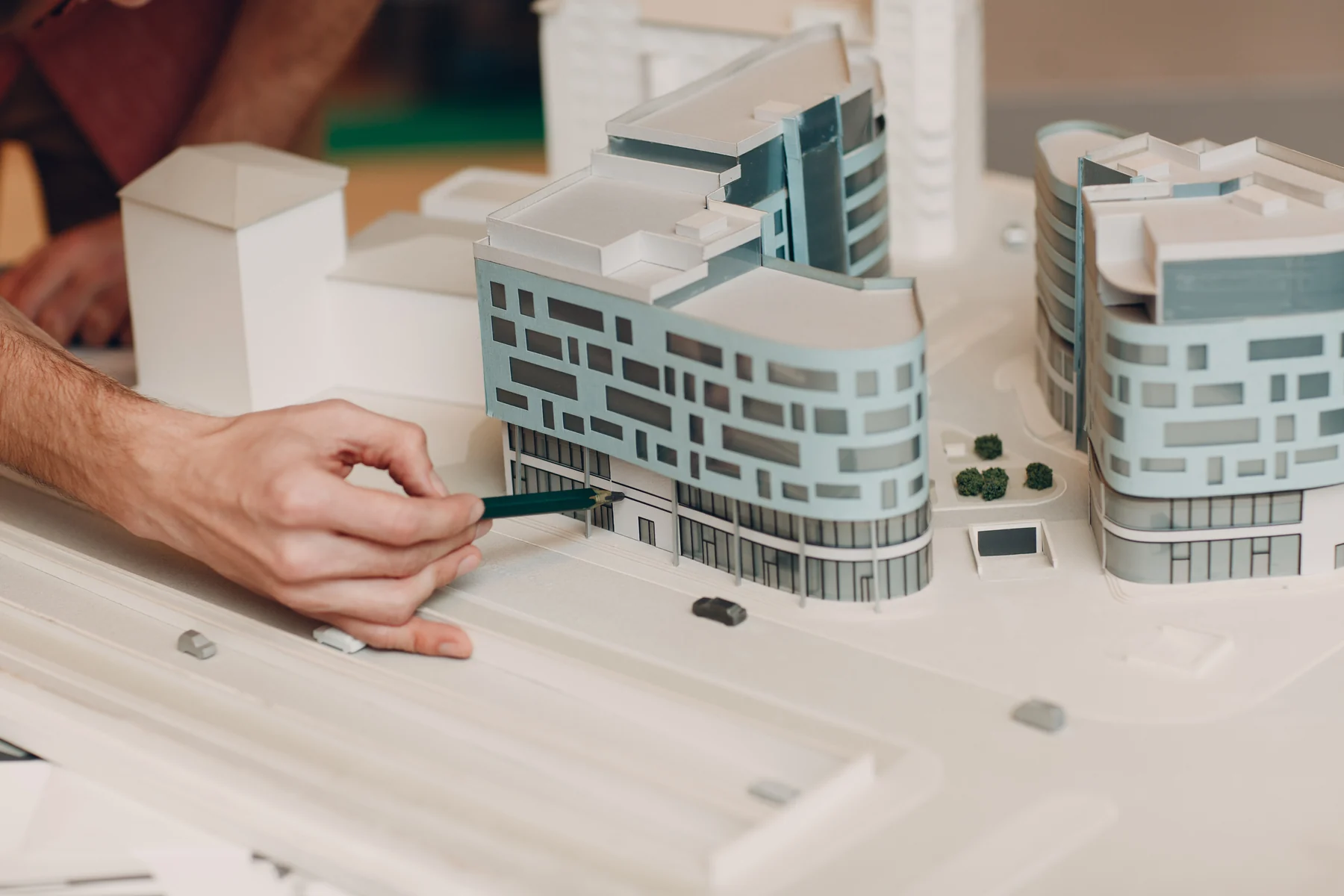
A physical model makes spatial choices visible. Credible campus development still depends on the users, operating responsibilities and access arrangements behind the proposal. Illustrative architectural-planning photography; this model is not a NEUVIOR or Vertex design.
atercorv · Architect Designs Building Model with Pencil at WorkplaceEnvato Elements commercial licence
Source and image notes
Full frame retained; EXIF orientation honoured, proportionally resized and encoded as WebP. No crop, creative colour grading, compositing or generative changes.
Founder analysis
Where does scientific infrastructure become a useful service?
An impressive campus image can hide the work that makes access dependable. Explore the links between a user’s task, technical support, governed access and a viable first phase. These are editorial tests drawn from operating campus examples, offered to make a proposed development easier for a serious participant to interrogate.
Editorial decision model, not measured NEUVIOR results.
A growth pathway should follow the work the company can govern.
A founder may need flexible support before needing a dedicated suite. The useful question is how the service and commercial arrangement can evolve as competence, funding and work change. An operating model should make those transitions explicit rather than assuming one accommodation product serves every stage.
Identify the next maturity transition the user needs to make.
Defined scientific user
A credible proposition starts with the user and the constraint it could remove. Sector labels and a list of equipment cannot establish willingness to pay, frequency of use or the support that a young company needs to make its work productive.
- Define the useful help
User requirement, maturity and current alternatives.
A useful next stepDescribe the task that the proposed campus would make easier.
A credible campus reduces a real user’s friction through services and responsibilities that can be examined.
The NEUVIOR design thesis
The current concept explores six proposed environments: formulation and analytical science, translational development, intelligent systems, clean advanced manufacturing, collaboration and headquarters, and shared campus infrastructure.
These environments are planning hypotheses. No laboratory, pilot line, robot, clean room or manufacturing suite shown in a visual exists as a NEUVIOR capability. Each would require its own user case, technical brief, safety basis, data controls, operator, financing, approvals and commissioning evidence.
The immediate value of the concept is therefore not a promise of completion. It is a disciplined way to expose dependencies. If a building cannot explain its users, operating authority, evidence threshold and path to economic use, it is not ready to become a commitment.
What investors should ask next
Investors should ask for the demand evidence behind each environment, the rights attached to any site, the distinction between adjacent assets and contracted access, the operator and licence model, the utilities basis, the capital sequence, the downside case and the decision gates that can pause or stop the project.
Good answers may still contain uncertainty. The mark of quality is that the uncertainty is named, owned and tied to a next proof point.
Conclusion
The strongest science campuses make complex work easier to perform and easier to govern. Their credibility rests on functioning relationships between people, infrastructure, support, access and accountability.
NEUVIOR is applying that lesson at concept stage. The standard is simple to state and difficult to meet: build only what a verified operating model can justify, and describe only what the evidence can support.
Questions and answers
What is a science campus?
Answer: A science campus is a place and operating system that brings together scientific organisations, specialist spaces, infrastructure, support and governed routes for collaboration or growth.
Is a science campus the same as a business park?
Answer: Not necessarily. A credible science campus normally has a defined scientific purpose, specialist infrastructure or support, and an operating model suited to research, development or technical companies.
What should investors examine in a proposed science campus?
Answer: They should examine demand, site rights, planning, utilities, operator responsibility, licensing, access agreements, capital phasing, downside cases and evidence for each claimed capability.
Is NEUVIOR an operating science campus?
Answer: No. It is a predevelopment proposal. The campus environments shown on this website are proposed and remain subject to evidence, approvals, funding and delivery.
Sources and attribution
UK Research and Innovation research campuses and clusters
Note: Updated 24 February 2026. Supports the description of distinct scientific focus, flagship facilities and support models.
Source: https://www.ukri.org/what-we-do/commercialisation/research-campuses-and-clusters/
UK Research and Innovation research and innovation campuses
Note: Updated 21 April 2026. Supports the discussion of specialist facilities and connected scientific communities.
Babraham Research Campus operator article
Note: Published 9 January 2026. Illustrates progression from managed shared laboratories to independent space.
Cambridge Biomedical Campus overview
Note: Accessed 1 August 2026. Supports the comparator description only.
Stevenage Bioscience Catalyst
Note: Operator page updated 26 August 2025. Illustrates specialist focus, shared facilities and support.
Alderley Park laboratory space
Note: Accessed 1 August 2026. Illustrates a range of flexible laboratory formats.
Harwell Campus overview
Note: Accessed 1 August 2026. Illustrates identified governance and national scientific infrastructure.















